‘It will be us’: Former Australian of the Year is building her answer to OpenAI
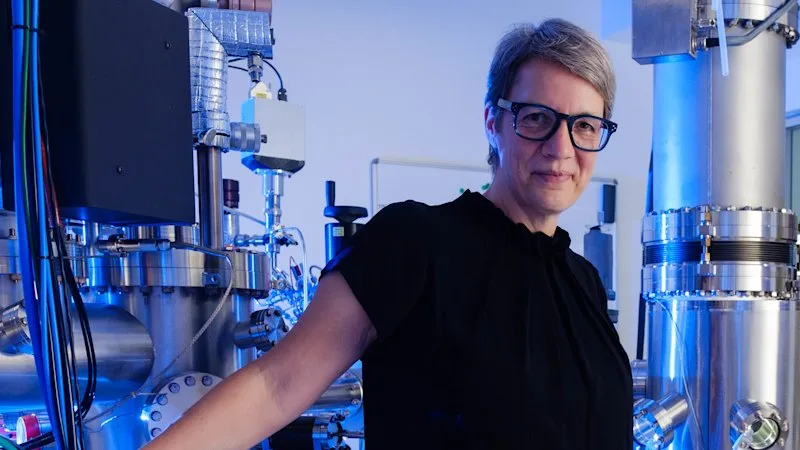
A former Australian of the Year is establishing what she calls a world-first atomic-scale chip plant in Sydney in a bid to make her company Australia’s answer to OpenAI.
Michelle Simmons, founder and chief executive of Silicon Quantum Computing, was asked at the John Monash Foundation oration on Thursday evening whether Australia could produce a quantum equivalent of OpenAI or Anthropic. “Yes, it will be us,” she said.
“We are establishing an atomic-scale manufacturing plant in Sydney. It’s the first one in the world,” she told the audience at the Commonwealth Bank’s Sydney offices.
An SQC spokesman said the company was expanding its manufacturing with “a new facility to be announced”, but would not say where it would be, when it would open or what it would cost.
Ordinary computer chips store information as ones and zeros. Quantum computers store it in the quantum states of individual atoms or particles, which in theory lets them solve problems beyond any conventional machine, such as simulating molecules to design new drugs, batteries and materials. Those quantum states are fragile, and no company has yet built a quantum computer that can correct its own errors at a useful scale.
SQC makes its chips by placing individual phosphorus atoms in silicon, a technique Simmons and her team spent 25 years developing at UNSW.
The federal government’s $15 billion National Reconstruction Fund has put $60 million into SQC this year, alongside London venture firm Firgun Ventures and Tin Alley Ventures. The spokesman said that money had “played a key role” in the new facility.
The plant comes as SQC’s first product, a chip called Watermelon, starts to find buyers. Watermelon is not a full quantum computer. It works alongside conventional AI models to sharpen their predictions, and Simmons said tests with energy multinational Schneider Electric had improved the accuracy of next-day energy network forecasts by an average of 20 per cent.
She said Watermelon had five paying customers: Schneider, Telstra, the Commonwealth Bank, the Defence Department and a high-frequency trading firm that has not been announced.
CBA and Telstra are both early investors in SQC. A CBA spokesman described the bank’s use more cautiously, saying it had been experimenting with the chip “to see where the technology might be of benefit”.
Simmons said demand was outstripping what SQC could make. “Since the announcements of both Telstra and Schneider, we have literally tens of customers trying to get in there,” she said. “The challenge we’ve got now is how to make more of that product quickly so we can get it out into the hands of more customers.”
She said SQC was standing by its target of a full, error-correcting quantum computer by 2033. The company has modelled its timeline on conventional computing, which took from the first transistor in 1947 to the arrival of personal computers in the early 1980s. SQC built its first single-atom transistor in 2012.
“The error-corrected processor, the 2033, is the 1981 equivalent,” Simmons said.
5News aggregated this summary from the outlet’s public feed. The full article, with all the context, is on www.brisbanetimes.com.au — the content belongs to Brisbane Times.