‘Hoaxes’: Migrant border rush sparked by Israeli, Russian misinformation, Spanish leaders says
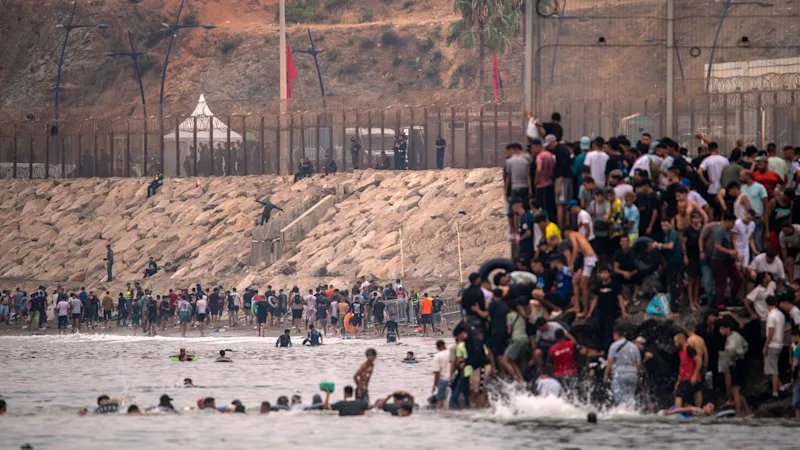
London: Spanish Prime Minster Pedro Sanchez has blamed networks in Israel and Russia for spreading online claims that led at least 72,000 migrants to cross from Morocco into the enclave of Ceuta in a border crisis four weeks ago.
Sanchez dismissed online claims that Moroccan authorities had encouraged migrants to swim to the Spanish enclave in northern Africa, saying the crisis was triggered instead by online misinformation spread by others.
But his claims were denounced by Israeli Foreign Minister Gideon Sa’ar, who said the Spanish leader was “lying shamelessly” to distract attention from his failures in government.
The dispute highlights the political tension over the Ceuta crisis when Sanchez is under fire over his migration policies at the same time he criticises Israel over its wars in Gaza and Lebanon.
Claims and counter-claims have spread online about the crisis ever since thousands of people stormed through border checkpoints on July 30 to get to Ceuta, an autonomous Spanish city surrounded by Morocco.
One factor appeared to be a belief among migrants that entering Ceuta would entitle them to asylum in mainland Spain under a Supreme Court ruling in June that said Spanish authorities could not summarily deport asylum seekers without due process.
Sanchez told broadcaster Cadena SER that false claims about the court ruling were spread online, and that the “far-right movement” used the crisis to attack Spain and divide European leaders.
“There were Russian and Israeli networks that spread these hoaxes and attacked the Spanish government and Europeans on a corrosive issue like irregular migration, which divides and polarises many European societies,” he said.
Sanchez said the online posts distorted the court ruling and spread the false idea that it would be impossible for Spanish authorities to force people back to Morocco.
“This type of hoax was used and spread through social media. This is what we know,” he said, in reporting of his remarks by Spanish daily newspaper El Pais .
Spanish police dealt with the crisis by forcing most of the migrants back to Morocco, although about 5000 remain in Ceuta despite the challenge of gaining food and water when many local people do not want them in their city.
While some media reports on July 30 said Moroccan border guards encouraged the migrants to cross into Ceuta, the Spanish leader rejected the theory that Morocco sparked the crisis because it seeks sovereignty over Ceuta.
Sanchez said at “no intelligence agency with which the Spanish government regularly collaborates” raised any concern about the involvement of Moroccan authorities. This included Spain’s own National Intelligence Centre.
European leaders are at odds over how to toughen border checks under the Schengen pact that allows free movement between 29 member states.
5News aggregated this summary from the outlet’s public feed. The full article, with all the context, is on www.smh.com.au — the content belongs to Sydney Morning Herald - Home.