The universe is full of strange ‘little red dots’. A new study shines light on their real nature
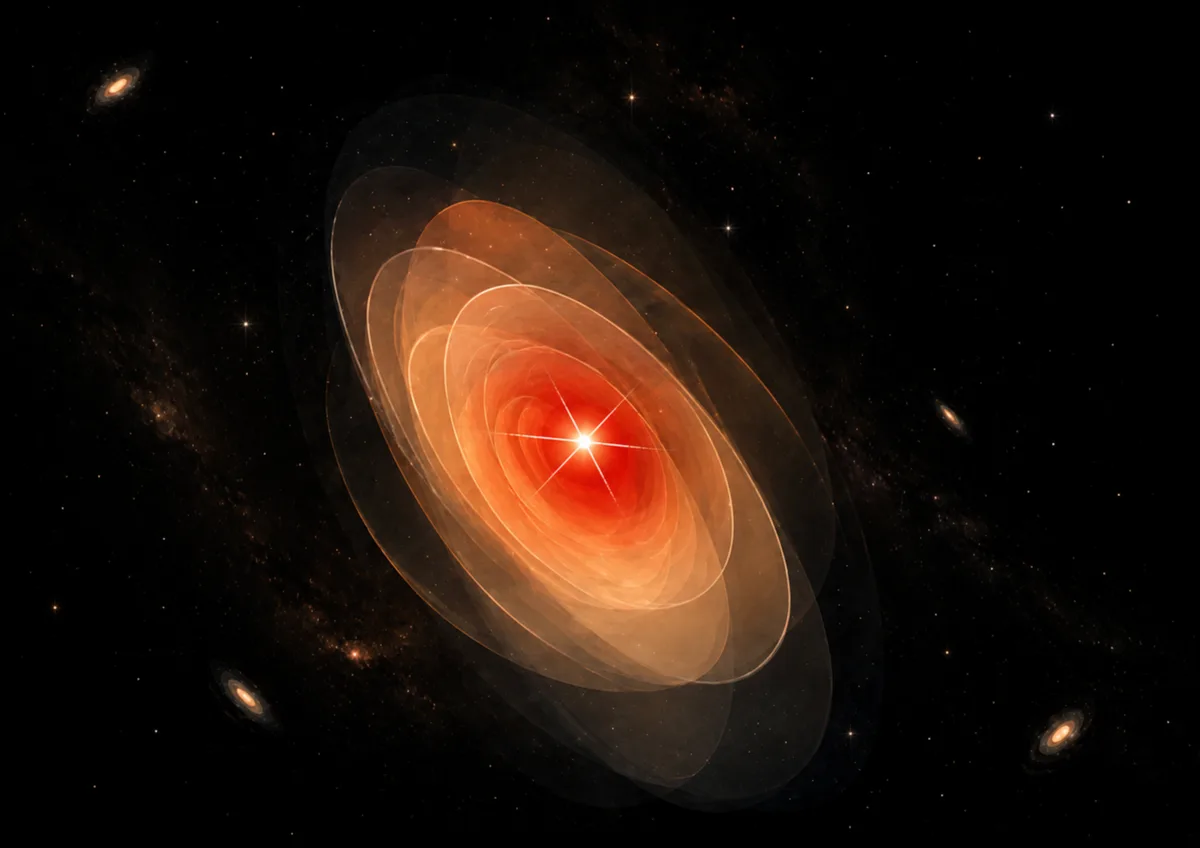
An artist’s impression of a little red dot in the early Universe, showing a bright, compact central source embedded within a faint host galaxy.
Ruiyuan Guo & Xuheng Ding In 2023, the James Webb Space Telescope revealed something strange: the distant reaches of the universe are filled with “ little red dots ” that astronomers still can’t quite explain.
But a new paper I coauthored, published today in Nature Astronomy, might have found the key to understanding their nature.
It turns out these little red dots might actually be evidence of the earliest supermassive black holes.
And they could hold clues to how stars and galaxies formed in the earliest years of the universe.
Discovering the unexpected The James Webb Space Telescope is the most powerful telescope ever made and has enabled the discovery of things we had never imagined.
This is the case for little red dots .
Their name is a simple derivation of their appearance: they appear as very small compact dots that are “red” in colour (noting the James Webb Space Telescope sees in the infrared ).
These objects are extremely distant , and are seen at an epoch when the universe is only around one billion years old (based on the time it takes the light to reach us).
Their compact size and extreme distance mean that most of their light comes from an area smaller than 2% of the size of our Milky Way galaxy .
Deciphering the dots Despite finding many of these distant objects, astronomers are still unclear what they might be.
The current favoured theory is that most little red dots are young supermassive black holes , with some consuming matter at such a feverish rate that their “surface” acts like the surface of a star (termed “ black hole stars ”).
Another theory is that some are regions of extreme star formation that form the most massive galaxies in the universe .
To help unravel the mystery of little red dots, astronomers have been looking to the host galaxies they reside in for answers, aiming to understand how galaxies and supermassive black holes grow in tandem with each other.
5News aggregated this summary from the outlet’s public feed. The full article, with all the context, is on theconversation.com — the content belongs to The Conversation Australia.