The art of the elbow: Why art fairs can be a full-contact sport
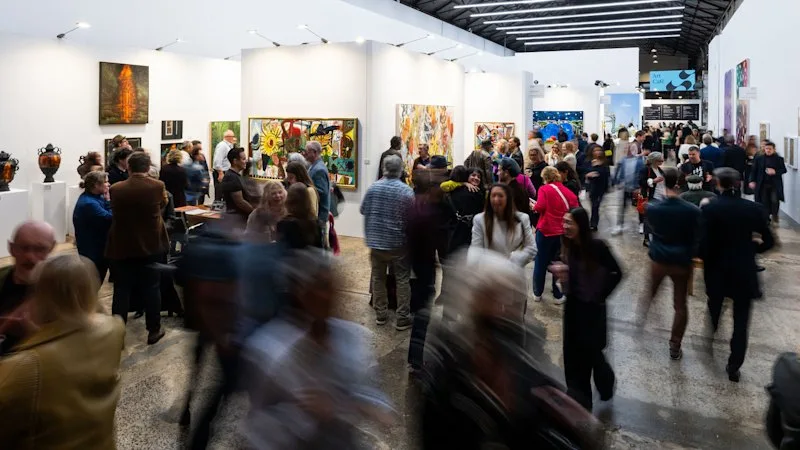
It’s about five minutes before the doors open. Massive queue. It’s Sydney Contemporary, the annual art fair held at Carriageworks and the artist in the sight-line of every serious collector is Yolngu artist Dhambit Munungurr. When the doors finally open, a herd of stylishly clad, mostly polite, elephants are unleashed.
By the time I got to the Roslyn Oxley booth back in 2023, thousands and thousands of dollars of the cerulean blue work of this Indigenous artist had a red sticker by its side. Sold. Sold. Sold. I’m not even in the ballpark for buying the work – but nothing like observing an art frenzy. Yes, there’s been a four-year decline in turnover but a record numbers of visitors. And The Art Basel and UBS Art Market Report 2026 found that by the end of last year, art sales were recovering but not yet returned to their 2022 peak.
Art fairs are the place to be if you want to see almost every contemporary Australian artist at the same time. No need to spend every Saturday going gallery to gallery. No need to bother with the pointlessness of trying to buy art online where everything seems shinier than it really is.
This year, the fair’s tenth, there are more than 100 gallerists, mainly from Australia, a handful from elsewhere. And never mind the gallerists. There are more than 500 artists from all over the nation. The ones who normally exhibit only in Melbourne, only in Adelaide, Brisbane and beyond.
For the first time, Sydney Contemporary will do what international art fairs have done for yonks – a two-hour block for VIPs to get first look, before anyone else. What does it take to get an invitation? Nominations from galleries and a long-standing commitment to spending on the visual arts. Zoe Paulsen, in her third year as fair director, says the organisers responded to feedback from both galleries and collectors. “They indicated we needed a shorter window, more considered conversations around significant works, before the fair becomes quite busy.”
Busy is one word for it. Elbows out might be another way of putting it.
I’ve watched Karina Harris and Neil Hobbs collecting for a few years now. They have a massive private collection, more than 1000 works in their Canberra home and Sydney apartment, an overflow in storage. They run the Canberra Biennial. And they are all business when they arrive at any art event. “If we like it, we buy it,” says Hobbs. Straight away.
Why does it matter to be first in the queue? “If you’re keen on somebody’s work in particular, this might be the only chance you’re going to get. We’ll do a quick whip around at midday so you don’t get stuck talking to people. Then when all the crowds come in, you can go back in and relax a little,” says Harris.
And last year, they did exactly that. The work of much-mourned Indigenous artist and award-winning poet Lionel Fogarty, who died earlier this year, flew off the walls of Darren Knight’s booth. The very earliest purchasers that day of a giant work by Fogarty? Hobbs and Harris. They bought the 2.4-metre by 1.5-metre work Connoisseur .
Nikita Le Messurier, 35, used to fly into Sydney from St Kilda in time for the fair.
5News aggregated this summary from the outlet’s public feed. The full article, with all the context, is on www.smh.com.au — the content belongs to Sydney Morning Herald - Culture.