Trump set to explode if his man does his job
“Fed Week” has started with a bang, with the world’s benchmark interest rate breaking through a key threshold and oil prices surging solidly above $US100 ($140) a barrel again.
When the members of the Federal Reserve Board’s Open Market Committee, which begins its two-day meeting on Monday afternoon (Washington time), sit down to decide whether or not to lift their policy rate, they’ll also have to factor in the hotter-than-expected inflation data from late last week.
Financial markets have no doubt what they’ll decide: they’ve priced in a 25 basis point cut at this meeting and at least two more, and perhaps three, similar moves between now and June next year. The probability of a rate rise at this meeting is priced at about 90 per cent.
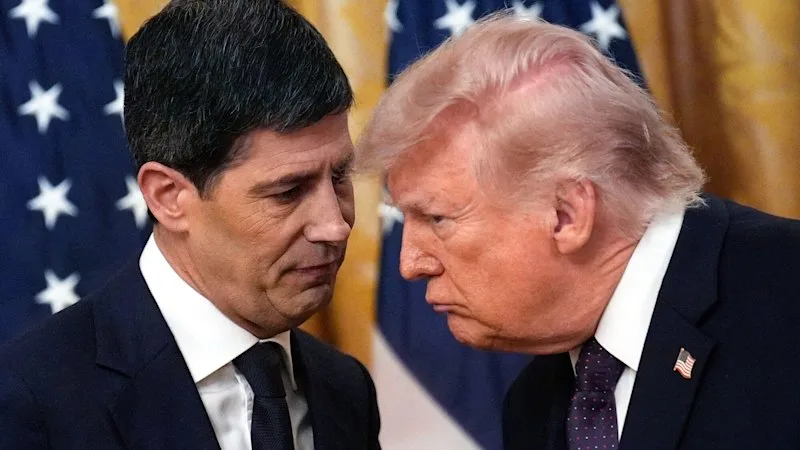
If the Fed does as the markets expect and raises the federal funds rate for the first time since July 2023, when it was still dealing with the inflation shock generated by the post-pandemic disruptions to global supply chains, it will be on a collision course with the Trump White House .
At the weekend Donald Trump again said the US should have the lowest interest rates in the world and again threatened to cut off trade with countries which have a trade surplus with the US if the Fed didn’t lower US rates (even though ending trade with most of America’s trading partners would help lower US interest rates would be more likely to lift the US inflation rate and interest rates than lower them).
Kevin Warsh, handpicked by Trump as chair of the Fed, is in an awkward position, partly of Trump’s making, but compounded by his own decisions.
Trump’s trade wars and his war in the Middle East have bled into the inflation rate and American households’ costs of living.
Last week’s inflation numbers showed a rise in headline inflation of 40 basis points between July and August, to 3.4 per cent. The inflation rate has now been above the Fed’s 2 per cent target for five and a half years.
The war in the Middle East has raged for nearly seven months, with no end in sight. Oil prices have rocketed from around $US60 a barrel before the US and Israel attacked Iran in February to about $US106 a barrel this week, having been above $US107 a barrel on Monday.
US gasoline prices have risen about 45 per cent and diesel prices 60 per cent as a result of the war, with the average price of diesel – the key transport fuel – moving above $US6 a gallon for the first time last Friday. It’s now at $US6.23, compared with $US3.76 a gallon just ahead of the onset of the war.
The longer the war drags on – the longer diesel and gasoline prices remain elevated – the greater the likelihood that the fuel costs that businesses appear to have largely absorbed to date will bleed into the wider economy and more materially into the inflation rate.
The impact of Trump’s trade war seemed to have passed through the economy and the data earlier this year, having a one-off effect on goods inflation, but then Trump announced a new suite of global tariffs – and a punitive new tariff regime for Canada – that will prolong the tariffs’ impacts on prices.
Warsh hasn’t helped himself.
5News aggregated this summary from the outlet’s public feed. The full article, with all the context, is on www.watoday.com.au — the content belongs to WAtoday.