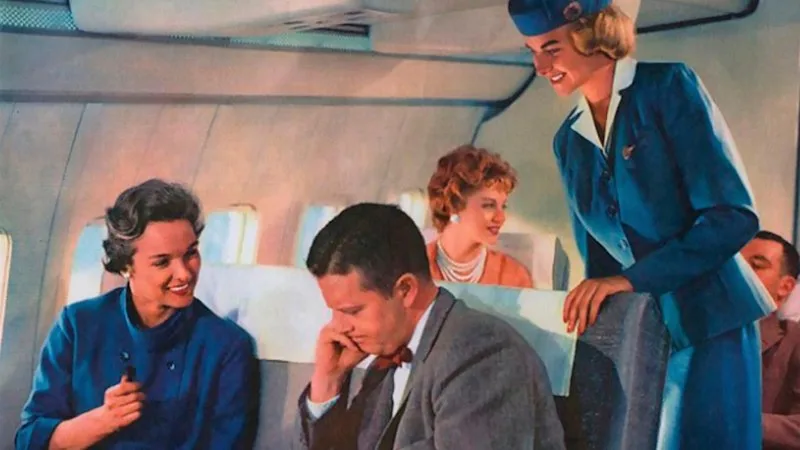
Height restrictions, marriage bans and VIP passengers: The life of a 1950s flight attendant
For decades, a tiny Olympic badge, bearing the five rings and the US shield, sat in a glass display cabinet in our home in Mooroolbark, in Melbourne’s eastern suburbs, beside my mother’s navy-blue air-hostess hat. The cabinet is now in her lounge in Montrose. I always knew the badge was there. I just didn’t know its story.
One day, while visiting from London, I was looking through the memorabilia on the shelves when I asked her about it.
My mother, Olivia Cornwell, is now 96. In 1956, she was Olivia Hudson, 26, a Trans Australia Airlines (TAA) air hostess (as they were known in those days) renting a room in Alma Road, Caulfield North. Jesse Owens was in Melbourne for the Olympics as the US Ambassador of Sports, appointed by then US president Dwight D. Eisenhower. He was already an international legend : at the 1936 Berlin Games, he won four gold medals in track and field, setting Olympic records and helping to shatter the myth of Aryan athletic supremacy.
On a flight from Melbourne to Sydney, he got talking to my mother. Before the flight was over, he had given her an official US delegation badge, a small token of the Olympic tradition of pin trading and goodwill. “We’d had a long chat,” she recalls, smiling. The pin was one of the memories she kept from that year.
Australia was changing. Television had just arrived. Waves of European migrants were reshaping the character of the major cities. The 1956 Melbourne Olympics, the first Games ever held in the Southern Hemisphere, were the country’s grand debut on the world stage.
Owens was just one of the many remarkable passengers my mother flew with during her year with TAA, aboard rumbling DC-3s and sleek British Vickers Viscounts: then-PM Robert Menzies and his wife, Dame Pattie Menzies; ALP deputy leader Arthur Calwell; Indigenous leader Sir Douglas Nicholls; actors, dignitaries, graziers and more. But before she could fly, there was the interview. Then there was the training.
After returning from six months overseas, travelling from Melbourne to the UK and Europe via the Suez Canal on the SS Oronsay and back on the SS Orontes, she was working as a preschool teacher and feeling isolated (“I only met mothers and kids”) when she saw a magazine story about a TAA hostess.
“I loved the uniform and the idea of travelling around Australia and meeting people,” she says. “I rang TAA. They invited me into town to see them. I wore a tweed outfit and a beret I’d got in Paris and sat in front of these six men in suits, chattering my head off, as I did in those days. The next thing, I was being fitted for the uniform by an awful old tailor bloke who was patting us everywhere while breathing heavily. That was pretty disgusting.”
Olivia was five feet three inches [160 centimetres] tall, in keeping with the airline’s strict height requirements of five feet two inches to five feet six inches [157-168 centimetres]. She wasn’t married, which was another stipulation.
5News aggregated this summary from the outlet’s public feed. The full article, with all the context, is on www.theage.com.au — the content belongs to The Age - Home.