Seam me up, Scotty! After 60 years, Star Trek has had a muppet takeover. About time too
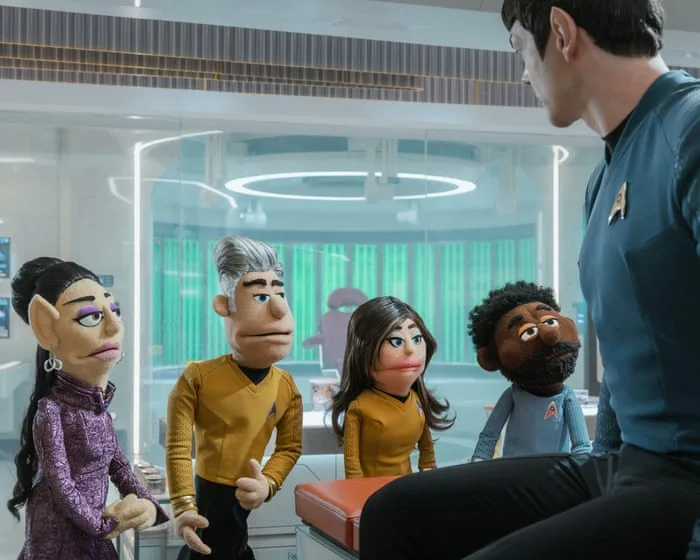
Star Wars has embraced the magic of puppetry since the 70s, but Trekkers have been starved of any muppet action … until now. The creators of Strange New Worlds talk about boldly sewing where no one has sewn before
In fact, when it comes to the latest episode of Star Trek: Strange New Worlds, the life forms in question are less flesh-and-blood and more fabric-and-felt – as the series becomes the latest sci-fi show to embrace the magic of puppetry.
Level-Five Transporter Accident follows in a longstanding Trek tradition that sees crew members undergo unfortunate transformations while beaming up to the ship. This time, the crew suffers an even greater indignity: thanks to a spot of boldly sewing from the legendary Jim Henson’s Creature Shop, the Enterprise team are reconstituted into – quite literally – a bunch of muppets.
“I thought it would be a big swing for us, but we spent a lot of time discussing how to do it as a Star Trek episode,” says Strange New Worlds showrunner Henry Alonso Myers. “Because I knew if it didn’t feel like Star Trek then it wouldn’t work.”
It’s a major departure for the Trek franchise, which turns 60 next month. Across nearly 1,000 episodes and 13 movies, Star Trek has always eschewed the art of puppetry – in stark contrast to its cooler, younger sibling Star Wars . Luke Skywalker’s mentor Yoda in The Empire Strikes Back was just one of many iconic puppet characters who populated the original movie trilogy.
“The Star Wars universe has a very tangible, lived-in quality, which was different to a lot of science fiction at the time,” says Brian Herring, the British puppeteer who operated lovable droid BB-8 in the most recent Star Wars movies. “Back in the 70s and 80s, George Lucas was using every trick in the book to populate that universe, and that included puppets as well as people in creature suits.” Ever since, sci-fi and puppetry have gone hand-in-glove, from ET to Little Shop of Horrors, Gremlins and beyond.
Meanwhile, despite Star Trek’s six-decade commitment ‘to seek out new life’, the franchise has remained a puppet-free zone.
“Star Trek made a big commitment to makeup early on,” says Dr Chris Nunn, assistant professor of film at the University of Birmingham. “So aliens would typically be played by human actors under heavy prosthetic masks, and that trend has continued.”
So why the unexpected course-correction from a franchise about to enter its seventh decade? The answer, it turns out, is less about the magic of puppetry and more about the tropes of modern TV production.
“Doing a puppet episode is a TV concept,” says Myers.
5News aggregated this summary from the outlet’s public feed. The full article, with all the context, is on www.theguardian.com — the content belongs to The Guardian Australia - Culture.