What six failed predictions taught Australia about its future
There is one certainty about Jim Chalmers’ upcoming intergenerational report – it will be wrong.
Brimful with huge projections about how the federal budget, the economy and Australian society will look by the mid-2060s, it will outline a future markedly different to what we are experiencing today.
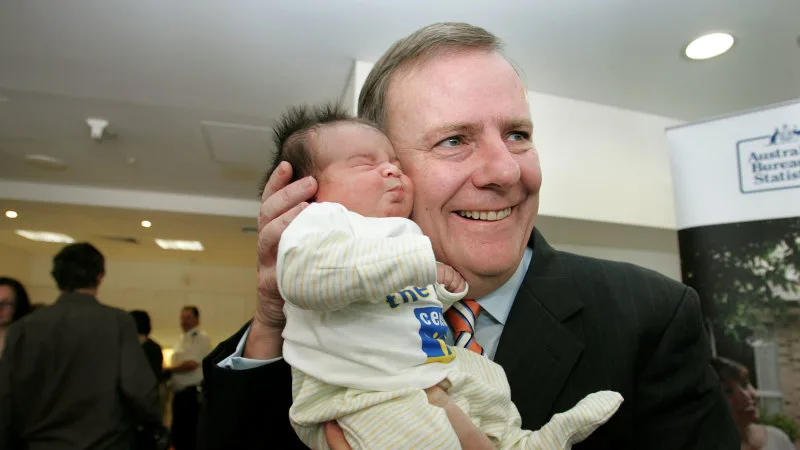
But, like the six previous iterations of this report that was first produced by Peter Costello in 2002, its prognostications are unlikely to be correct. And that is not a problem.
Costello’s idea was to examine the budget’s long-term demographic pressures by focusing on productivity, participation in the workforce and the nation’s population. They remain key to the document.
That first intergenerational report predicted the budget would remain in surplus until 2017 before a demographic tsunami overwhelmed the nation’s finances. In his second report in 2007, the tsunami had been delayed, with surpluses forecast until at least 2022.
But a year later an American investment bank called Bear Stearns collapsed, precipitating what we now call the global financial crisis and a 15-year string of budget deficits.
That’s the danger with making long-term prognostications. Something unforeseen can upend them all.
In his first report, Costello noted that it provided plausible insights into the nation’s fiscal future. “The results indicate a possible future, but within a wide band of uncertainty,” he said.
Costello and every other treasurer – Wayne Swan, Joe Hockey, Josh Frydenberg and Jim Chalmers – who has released an intergenerational report have warned that the nation would eventually face sizeable budget deficits.
Costello’s two reports forecast surpluses before running into deficits that would ultimately hit 5 per cent of GDP. Hockey, Frydenberg and Chalmers never forecast a surplus – just a sea of red all the way out to the 2060s.
While Swan’s 2010 report missed the current deficit, it was the only one to forecast there would be surpluses in 2022-23 and the following year.
Highlighting just how events can throw out forecasts, Frydenberg’s intergenerational report of 2021, compiled during the pandemic, forecast a deficit of 4.6 per cent of GDP for 2022-23. Instead, Chalmers would oversee a surplus of 1 per cent of GDP.
Deficits mean debt. And only the Chalmers report of 2023 – largely because it was so recent – has got close to accurately predicting the current level of net debt.
Swan believed the value of government assets would outweigh its debts to the tune of 5.5 per cent of GDP by 2026-27. Hockey was a little more circumspect, tipping net debt of 5 per cent of GDP for the same year before a rapid improvement.
5News aggregated this summary from the outlet’s public feed. The full article, with all the context, is on www.theage.com.au — the content belongs to The Age - Home.