Albanese takes climate warning to New York, but fossil fuel experts test credibility
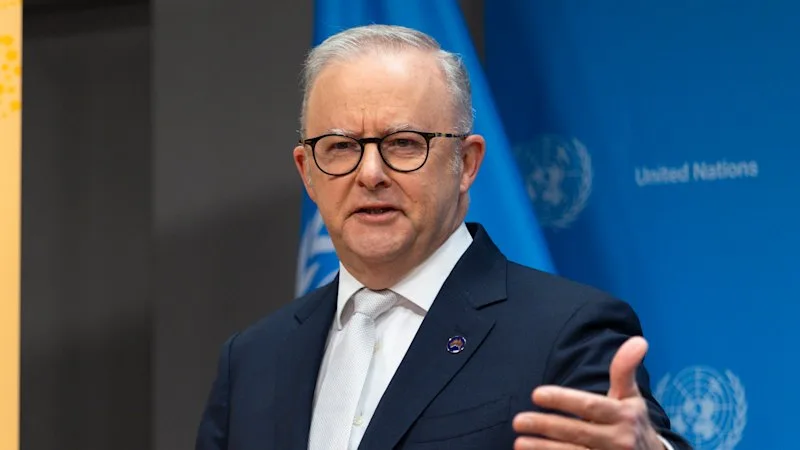
The world can no longer rely on adapting to escalating climate catastrophes, Prime Minister Anthony Albanese will warn as he opens Climate Week in New York with a warning that Australia is heading into a summer of extreme heat, bushfires and floods.
The prime minister will tell a United Nations gathering that Australia’s abundant renewable potential – firmed by gas-powered generation – can help deliver its emissions target while declaring the next devastating fire or flood is becoming a question of when, not if.
But as Albanese promotes Australia’s renewable energy gains, scientists say the government faces a credibility test given its continuing support for fossil fuel investment and status as one of the world’s largest fossil fuel exporters.
“We can’t rely on the fortitude of our people alone, as tough as they are,” Albanese will say, according to a draft of his speech. “We need to come together, to meet the problem head on.”
Albanese will point to record-breaking temperatures and unprecedented wildfires across Europe during the northern summer while acknowledging Australia and its Pacific neighbours are bracing for their own difficult months.
“With a record-breaking El Nino forecast, Australia and the Pacific nations are preparing for a potential summer of extreme heat, bushfires and floods,” he will say.
Australia’s 2035 emissions target of cutting greenhouse gas emissions by 62 to 70 per cent below 2005 levels will be central to the government’s case as it prepares to lead COP31 negotiations with Turkey.
He will acknowledge that not every extreme weather event can be directly attributed to climate change, but argue a warmer world is producing more frequent and intense event s.
“Unfortunately, without strong action, the science tells us these events will get worse and more intense,” Albanese says. “That’s more communities facing repeated trauma. Knowing the next flood or fire isn’t a matter of if, but when.”
Albanese will argue the 62 to 70 per cent target is “ambitious” but achievable, pointing to the rapid expansion of renewable energy and household batteries.
Renewables supplied about half the grid at peak periods last summer, while more than 500,000 household batteries have been installed over the past year. But Australia’s climate credentials will face a tougher test as it takes on the presidency of the COP negotiations.
Jennifer Morgan, a senior fellow at the Fletcher School of Law and Diplomacy at Tufts University and former climate envoy for Germany, said Australia and Turkey were both pursuing potential new fossil fuel investments and had no coal phase-out date.
“They’ve made progress in renewable energy, but I think their credibility – and their ability to therefore bring momentum and good outcomes to the COP – will depend on their taking further action at home,” Morgan said.
Natalie Jones, a senior policy adviser at the International Institute for Sustainable Development, said Australia and Turkey needed to provide “clear leadership” on transforming the fossil fuel road map agreed at last year’s COP30 in Brazil into concrete action.
5News aggregated this summary from the outlet’s public feed. The full article, with all the context, is on www.smh.com.au — the content belongs to Sydney Morning Herald - Home.