What is this mad, gloomy, thoroughly undramatic spectacle supposed to be about?
DANCE Now or Never Festival | Time Remaining ★★ Chunky Move, Melbourne Town Hall, until August 20
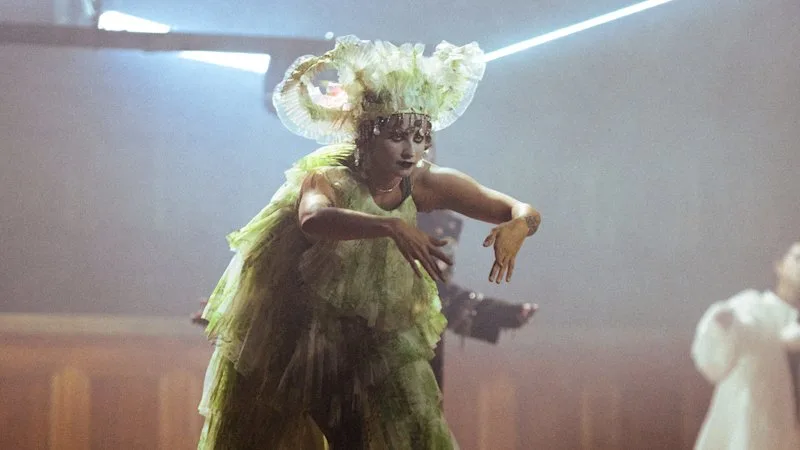
I admit that I’m baffled by Antony Hamilton’s Time Remaining . What is this mad, gloomy, thoroughly undramatic spectacle supposed to be about? And what exactly are those poor dancers in their dowdy costumes doing?
The program is no help. It tells us that the show “explores the technical integration of scenic lasers within live performance”. Technical integration? Really? Is this an exercise in systems engineering, then? Not choreography but logisticality?
Well, the dance and the laser show might be technically integrated, but they’re not integrated in any more meaningful sense. Time Remaining is like two separate performances accidentally occupying the same venue – though neither manages to fill the space.
The production is vacuous in the precise sense that it lacks content. In the vast cavern of the Town Hall, everything feels far away and ineffectual, especially when viewed from the balcony seats: a handful of dark figures scurrying through the lights or just waiting about.
There are four laser units mounted on racks suspended from the ceiling. Thin purple beams traverse the hall, slowly and repetitively, producing eerie blue shimmers on its walls. The arrangement is stark and simple and might have made an interesting gallery installation.
The precision of the lasers contrasts strongly with purposelessness of the dancers. Costumed in a Gothic gallimaufry of theatrical hand-me-downs, they writhe in slow motion on the raised stage or caper through the hall like shrieking children.
There is some dance, but it’s so wilfully impoverished that one is forced to wonder whether this production is actually a rejection of live performance – especially the work of choreographing human bodies.
Whatever fascination this performance has belongs to the lasers: the orderliness and constancy of the beams, their innate intensity, their capacity to cut through darkness and the precision with which they can be choreographed.
Beside them, the dancers seem almost superfluous: messy, obsolete and absurdly old-fashioned. What are they doing down there? They’re disappearing. Reviewed by Andrew Fuhrmann
MUSIC Stravinsky, Mills and Shostakovich ★★★★★ Australian World Orchestra, Hamer Hall, August 19
Now celebrating its 50th anniversary, the annual ritual of bringing together Australia’s finest orchestral musicians under the banner of the Australian World Orchestra has rightly become an eagerly anticipated fixture in the nation’s musical calendar.
Expert musical storytelling characterised this year’s program, one in which a curious set of Australian fables was bookended by two Russian classics.
Really a concerto for orchestra, Stravinsky’s ballet Petrushka (presented in the revised 1947 version) allowed many of the AWO’s talented players to bask briefly in the limelight as the story of the puppet Petrushka’s being brought to life unfolded.
5News aggregated this summary from the outlet’s public feed. The full article, with all the context, is on www.smh.com.au — the content belongs to Sydney Morning Herald - Culture.