What makes Australia one of the safest countries in a doomsday scenario?
Australia could be one of the safest places on Earth if, or rather when, a global catastrophe strikes.
New research has found Australia's isolation, self-sufficiency, and political stability mean it can withstand most crises.
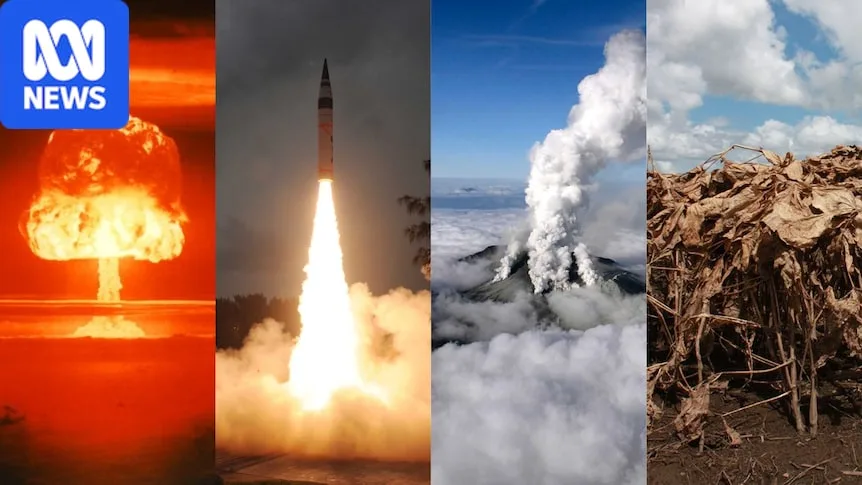
The catastrophe could be anything from nuclear winter to asteroid strikes, or even a technological doomsday.
But researchers warn no country would escape unscathed, and resilience may depend as much on local communities as national borders.
By some definitions, any event that puts 10 per cent of human lives under threat is considered a global catastrophic risk.
These risks generally fall into three broad categories: abrupt sunlight reduction, catastrophic infrastructure loss, or global biological threats.
Matt Boyd, who co-authored the research in the journal Global Challenges, said such scenarios were not simply the stuff of science fiction.
"In fact, some of them have happened before, and some of them are guaranteed to happen," he said.
"Large magnitude volcanic eruptions have caused severe famines and even dynastic collapses, and they will happen again.
"And while COVID didn't meet the definition of global catastrophic risk as we've been studying it, it overwhelmed the capacities of the world."
Dr Boyd is also the executive director of Islands for the Future of Humanity, a resilience charity based in New Zealand.
His home country, along with Australia, ranked among the safest places in the world in many catastrophic scenarios.
Both are isolated, democratic island nations with the potential to be largely self-sufficient in food production, energy, transport, and communications.
But a key finding is that densely populated cities may be particularly vulnerable to global catastrophic risks.
5News aggregated this summary from the outlet’s public feed. The full article, with all the context, is on www.abc.net.au — the content belongs to ABC News Australia - Top Stories.