The greatest scientific mystery of our time may have just flashed in a gold mine
Sometimes it feels as if all the fundamental questions about existence have been solved. Then you remember dark matter.
This unknowable substance constitutes as much as 85 per cent of all mass in the universe, and yet we cannot see or directly measure it, and we don’t know what it’s made of.
But the structure of spiralling galaxies, the make-up of the cosmos, and indeed our very existence only make sense if the universe is woven with an undiscovered, invisible essence, holding it all together like a secret skeleton.
Needless to say, dark matter is the greatest scientific mystery of our time.
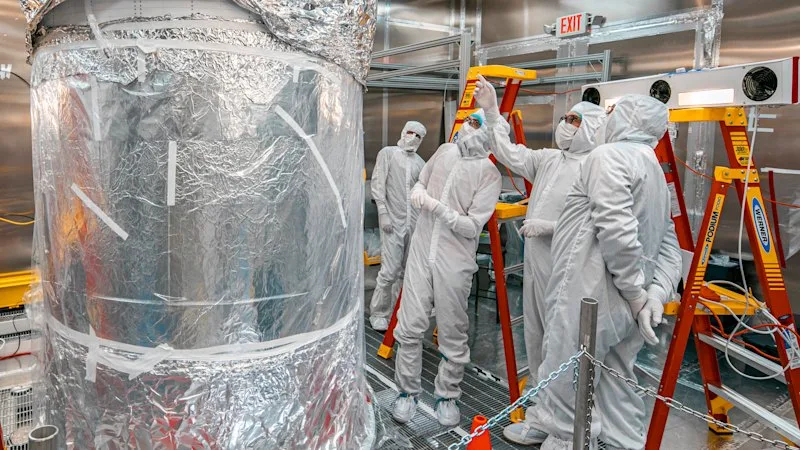
That’s why physicists are intensely excited about a tiny spark of light detected in a pool of liquid xenon in the depths of an abandoned goldmine.
The data is limited and fresh, and scientists are duly cautious. But there is a possibility this newly reported signal could be the first-ever detection of dark matter.
Fritz Zwicky was an unconventional and at times unpopular scientist who once said of his more orthodox colleagues: “Astronomers are spherical bastards. No matter how you look at them, they are just bastards.”
The Swiss stargazer was investigating the Coma galaxy cluster in 1933 when he realised the galaxies were rocketing around each other at 2000 kilometres per second – so fast they should have violently flung away from each other.
He calculated the galaxies, to summon enough gravity to stay together, must have 400 times more mass than they appeared to have. What was providing this invisible gravitational glue? He proposed the existence of dark matter.
Zwicky’s theory was treated as zany. Then American astronomer Vera Rubin spied another anomaly in the 1970s.
Stars on the outer edge of a galaxy should orbit much slower than those at the centre. But Rubin discovered the outer stars of a galaxy travelled just as fast as those closer to the centre.
The visible matter in the galaxies didn’t have enough gravity to hold on to these distant, fast-spinning stars. Something else was holding on to them. Rubin concluded: “What you see in a spiral galaxy is not what you get”, and that dark matter must be real.
Now astronomers can see how light is warped in space by gravity emanating from dense, invisible regions of suspected dark matter.
The image below shows galactic gas highlighted in pink, while the blue areas show regions of intense gravity scientists believe can only be explained by dark matter .
5News aggregated this summary from the outlet’s public feed. The full article, with all the context, is on www.smh.com.au — the content belongs to Sydney Morning Herald - Home.