In case it was ever in doubt, Jacob Elordi is a ‘dog person’
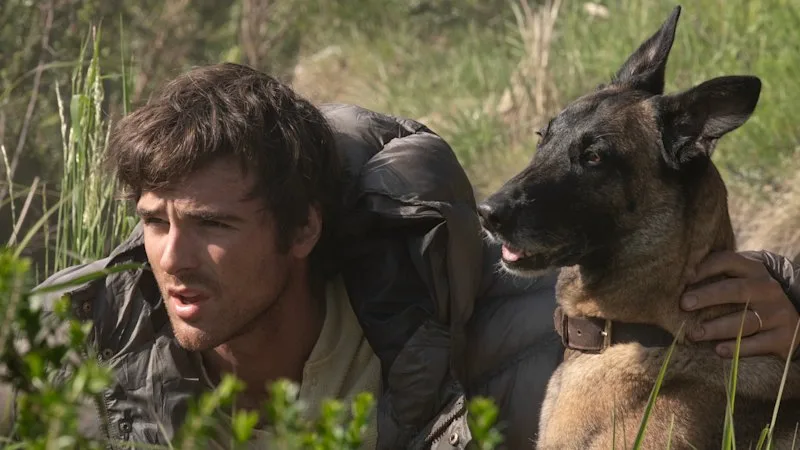
“You know, dogs for me are easier for me to act with than people,” says Jacob Elordi, who plays opposite a dog for a good portion of Sir Ridley Scott’s The Dog Stars .
Like all his answers, this one is slow and considered; Elordi doesn’t do throwaway lines.
“Because they never lie,” he goes on. “This dog is incredibly well-trained. Her sole job is responding to me, so it was kind of an easy task. [And] because her focus is entirely on me, she’s entirely dedicated between action and cut. The word ‘Action’ makes her spring to life and ‘Cut’ is when she knows she gets a reward. So in the scene, she’s probably the truest scene partner I’ve had.”
His director nods approvingly. “Dogs never lie!” Scott says. “Very true.”
Elordi’s bond with Jasper, a frisky Belgian Malinois, opens up some breathing space in this latest take on the end of the world as we know it, based on Peter Heller’s 2012 novel.
Hig (Elordi) lives in a remote camp a couple of hours’ flying time from what used to be Denver, now a deserted ruin since a virus killed all but a few survivors. The dog is the sole remaining member of Hig’s family; his wife died with their unborn child, leaving him consumed with grief.
Along with Jasper, he works alongside his compadre Bangley (Josh Brolin), a disagreeable former soldier who – as Hig observes – suits and even enjoys life on the edge of annihilation. Bangley picks off lone raiders from his lookout tower. Larger groups of ferals are seething out there somewhere, waiting to kill them.
It’s a fiercely lonely life, out of any town on an old airstrip, surrounded by hulks of light planes, one of which Hig has pressed into service. He flies into Denver – landing in the empty main street – to loot abandoned shops, hospitals and petrol bowsers, maybe calling in on his old house, which remains exactly as he left it, still with clean sheets on the bed. On the way back, he might call in on a nearby colony of Mennonites, who exchange their vegetables for his mechanical skills, much to Bangley’s chagrin; any one of them, he argues, could be carrying disease. He sneers at them, but has his own religious calling: to save his own skin.
Heller’s vision of a future dystopia has ceased to feel fanciful in the wake of the COVID pandemic. Actually, says Scott – who watches the world news at least twice a day – it is not even a future. “People are living apocalyptic lives right now. We won’t go into that because it will become political, but how stupid are we to ignore it, right?” he says.
“We are just the fortunate few who don’t have to experience that, but we see it. It’s there. And I think, in a heartbeat, we could be there.”
Elordi as Hig is calm, dogged, morose. “Hig is not a superhero,” observes the actor. “He’s not a soldier. He’s not a marine.”
Nor, for that matter, is he a romantic antihero like Heathcliff or Frankenstein’s monster.
“Mundane is the wrong word, but this is a very real apocalypse,” Elordi says. “And as he says in the film, he’s just a mechanic, a normal guy.
5News aggregated this summary from the outlet’s public feed. The full article, with all the context, is on www.smh.com.au — the content belongs to Sydney Morning Herald - Culture.