NATO to share responsibility for Arctic security
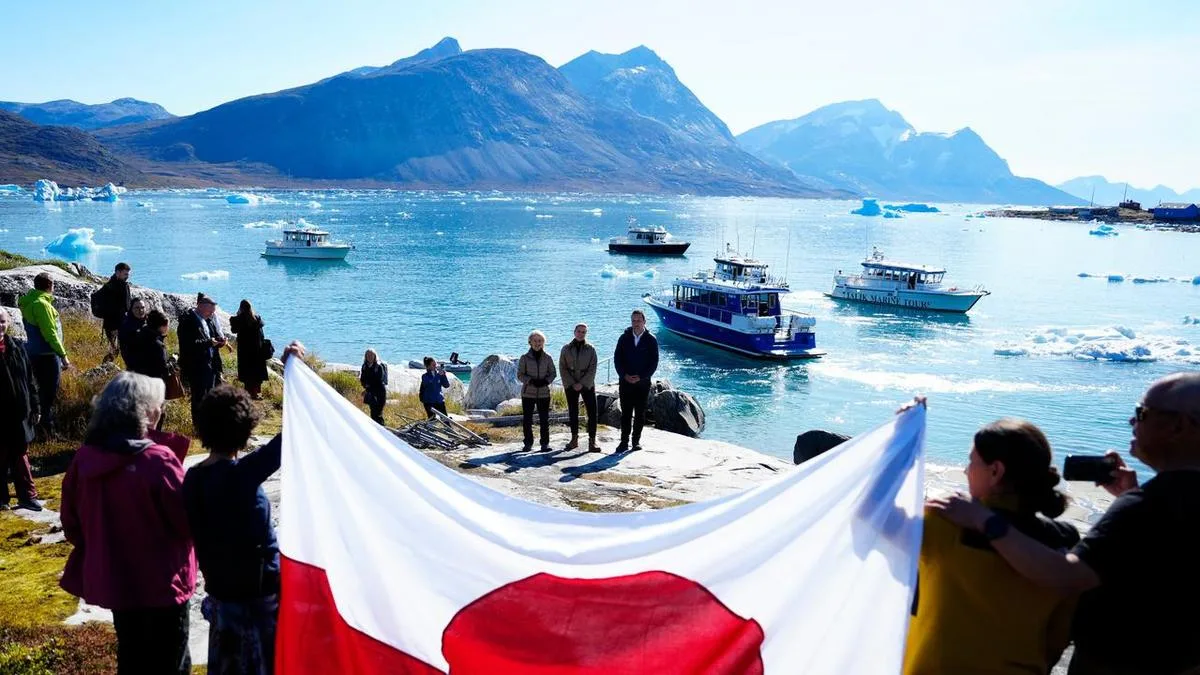
Denmark, Greenland and the US will sign a deal on Greenland's security that will put Arctic security under NATO's watch rather than leaving it solely to Washington and Copenhagen.
The agreement, to be signed at the UN General Assembly in New York at 10:30am on Tuesday (12:30am AEST Wednesday), has not been made public.
Denmark and Greenland say the deal will benefit the Arctic island and respect its sovereignty.
The deal is expected to allow the US, which already has one military base in Greenland, to expand its military presence to two additional sites.
One of those sites is Narsarsuaq, whose population has dwindled to a few dozen people since the US closed its Cold War-era Bluie West One military base there in the 1950s.
The other is Mestersvig, a military outpost currently used by the Sirius Dog Sled Patrol, a special forces unit that enforces Danish sovereignty in the territory, said two people familiar with the matter.
Trump will meet with Danish Prime Minister Mette Frederiksen and Greenland Prime Minister Jens-Frederik Nielsen in New York for a trilateral signing ceremony, a White House official said.
The deal follows months of pressure from Trump, who has said the US should control Greenland and at times refused to rule out using military or economic force to acquire the semi-autonomous Danish territory.
His threats peaked in January, triggering a diplomatic crisis within the North Atlantic Treaty Organisation, the military defence alliance, and pushing Denmark and Greenland into negotiations aimed at defusing the pressure.
The agreement "will be in a form where responsibility for security in the Arctic is not only Danish or American," Danish Foreign Minister Lars Lokke Rasmussen told national broadcaster TV2 on Sunday.
He said that to a large extent "it would be NATO that looks after the Arctic."
It remained unclear whether the deal amends an existing 1951 defence agreement that is the legal basis for the US presence in Greenland.
"It appears that we are now using this crisis to try to strengthen NATO's cohesion through Greenland," said Ulrik Pram Gad, a researcher at the Danish Institute for International Studies (DIIS).
Washington's strategic interest in Greenland dates back to World War Two.
5News aggregated this summary from the outlet’s public feed. The full article, with all the context, is on www.perthnow.com.au — the content belongs to PerthNow.