Tuesday 13 October 2026 SourcesAbout🌓
🇦🇺 AU ▾
BREAKING
› South Africa v Australia: first men’s cricket Test, day four – live› Zelenskyy says ‘increasingly clear’ Russia does not want energy ceasefire after strikes on energy facilities – Europe live› Cyber-attack defrosts refrigerators in two French supermarket chains› Wall Street opens little changed ahead of bank earnings› Catherine, Princess of Wales, and Princess Charlotte spotted riding London Underground› Sylvester Stallone and Arnold Schwarzenegger are now 'good friends'› Adam Pearson hails positive disability representation progress in film industry› Dame Judi Dench slams 'trigger warnings for 'mollycoddling' audiences› Hincapié and Zubimendi out after warm-down injuries but Arsenal get Saliba boost› 'Scary' dementia modelling shows how cases will surge by 2050› South Africa v Australia: first men’s cricket Test, day four – live› Zelenskyy says ‘increasingly clear’ Russia does not want energy ceasefire after strikes on energy facilities – Europe live› Cyber-attack defrosts refrigerators in two French supermarket chains› Wall Street opens little changed ahead of bank earnings› Catherine, Princess of Wales, and Princess Charlotte spotted riding London Underground› Sylvester Stallone and Arnold Schwarzenegger are now 'good friends'› Adam Pearson hails positive disability representation progress in film industry› Dame Judi Dench slams 'trigger warnings for 'mollycoddling' audiences› Hincapié and Zubimendi out after warm-down injuries but Arsenal get Saliba boost› 'Scary' dementia modelling shows how cases will surge by 2050
Science

Starwatch: Mars signposts the beautiful Beehive cluster
The Guardian Australia - Science ·
Starwatch: Mars signposts the beautiful Beehive cluster

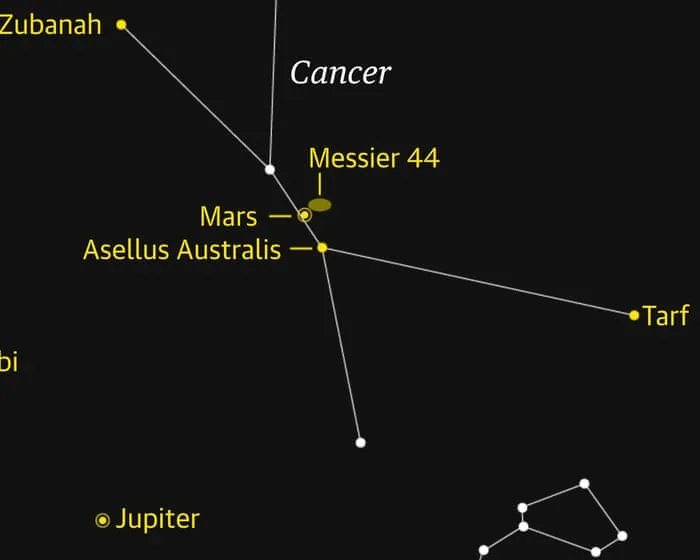
From a dark location, the Beehive – or Praesepe – will appear as a faint, misty patch very close to the red planet The red planet, Mars, sails through the beautiful cluster of stars known as the Beehive this week.

Catalogued as Messier 44, the cluster lies in the constellation Cancer.

It has been known since antiquity, when its hazy appearance earned it the Latin name Praesepe, meaning a manger or crib.

Although it is one of the brightest star clusters in the night sky, it can be surprisingly difficult to locate because Cancer contains no bright stars to guide the eye towards it.

Thankfully, this week Mars acts as the signpost.

Continue reading...

Read the full article on The Guardian Australia - Science ›

5News aggregated this summary from the outlet’s public feed. The full article, with all the context, is on www.theguardian.com — the content belongs to The Guardian Australia - Science.


More from The Guardian Australia - Science

See all ›

More in Science

See all ›