Forget Starbucks – welcome to the birthplace of China’s coffee industry
Yunnan, China: On a remote mountain slope in south-west China, bamboo trays of freshly picked red coffee cherries are drying in courtyards and on the rooftops of farmers’ homes in the tiny village of Zhukula.
Much of the fruit has been harvested from trees planted next to an old church more than a century ago by French missionaries who brought Arabica saplings, along with Catholicism, across the border from Vietnam.
The village’s nascent Christian conversion didn’t survive the religious purges of the Cultural Revolution, but the coffee trees are now recognised as the oldest in the country, making Zhukula the birthplace of China’s coffee cultivation.
In this corner of China, long days ploughing and harvesting the mountainside are book-ended by coffee, not tea.
“Ever since I was little, as far back as I can remember, there have been coffee trees growing all around here,” says Li Jinrong, 57, a third-generation coffee farmer.
“We make coffee as soon as we get up in the morning, drink it, go out to work and then have another cup before dinner.”
The village of Zhukula has just one road in and out for its 83 households, reachable only by driving for hours along slender hairpin bends that snake around a mountain range.
Li invites us into his farmhouse after we poke our heads through an open doorway leading to his courtyard, drawn in by a striking mound of yellow corn cobs baking in the sun and a noisy cat.
His home is a modest three-storey brick structure, centred around an open-air communal room with a concrete-slab floor. One corner functions as a kitchen, with a rice cooker and a camping stove rigged up to a single power board looped around a nail in the wall, while a collection of mismatched plastic stools surrounds a basic dining table.
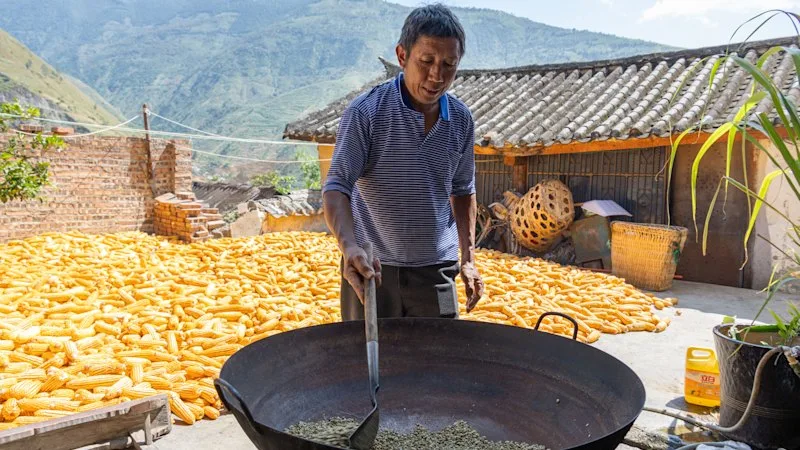
In the courtyard, he empties a rice sack filled with green coffee beans – shelled from their cherry skins – into a wood-fired roasting pit, fashioned out of an oil drum and large cast-iron work.
With a cooking shovel, he continuously turns the beans, a process that takes more than an hour to achieve a deep roast. It might seem nostalgically authentic, but it’s a laborious task that modern coffee manufacturers long ago outsourced to roasting machines.
While China’s surging taste for coffee helped drive global prices to record highs in 2025, few, if any, farmers in Zhukula have grown rich from coffee.
“We grow coffee beans to make a living, but coffee alone isn’t enough. The problem is that we don’t have much farmland here,” Li says.
“Coffee consumption [in China] has increased, but our area is small, so sales are unstable.”
5News aggregated this summary from the outlet’s public feed. The full article, with all the context, is on www.smh.com.au — the content belongs to Sydney Morning Herald - World.