This entire novel is one sentence. Somehow, it works
If awards ceremonies are anything to go by, the one-sentence novel is having a moment.
The Norwegian Jon Fosse and Hungarian Laszlo Krasznahorkai, winners of the Nobel Prize for Literature in 2023 and 2025 respectively, see the humble full stop as a needless barrier to be banished from their richly textured and deeply introspective novels.
Lucy Ellmann’s Ducks, Newburyport , a Goldsmiths winner and Booker shortlistee, is composed of a single sentence detailing the protagonist’s far-reaching anxieties that persist over a thousand pages, held together with the refrain “the fact that”.
These writers are rule breakers. They dispense with full stops, scene breaks, and chapters by using an array of conjunctions and punctuation, both workmanlike and exotic, to keep the damn thing rolling. Each page is a formidable, handsome wall of text. They write the literary equivalents of a horror vacui, a painting afraid of emptiness, a canvas completely covered.
Despite these books being a single, unbroken sentence, I doubt anyone reads them in one sitting, nor that the authors indeed intend for us to do so. You would need a preternatural concentration or heroic dose of stimulants. Likely both. They offer no restorative pit stops, no spaces to breathe, nowhere obvious to rest a bookmark and take stock of everything that has come before. You must rip yourself away from the currents, forever amid a gathering thought.
Once the books get going, however, the effect is a degree of immersion beyond that of conventionally stylised fictions. Sure, they make demands on us, but difficulty (more than idle, easily absorbed fiction) rewards. I find myself switching between two mental states: one of hypervigilance, following every thread, and another that lets the stream of words wash over me.
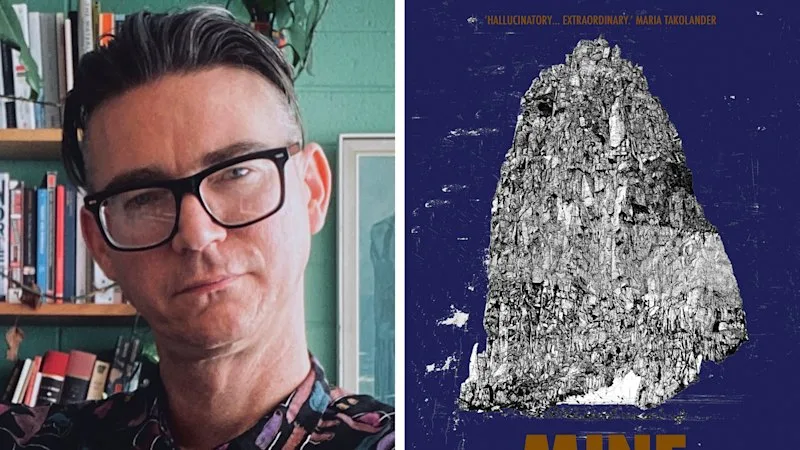
I’m no proselytiser for the one-sentence novel. I trudged through Mathias Enard’s Zone like an explorer with a machete chopping through an overgrown path. I never finished Ducks, Newburyport . And yet, the new novel from Tasmanian writer Adam Ouston has me, if not converted, at least showing up for Sunday service.
Ouston’s debut, Waypoints , took as its subject the lesser-known history of Harry Houdini’s first controlled flight, which happened in 1910 in Diggers Rest, Victoria. His latest novel, Mine , also embraces smoke and mirrors, but this time on the level of the sentence.
It begins after a poet falls into an abandoned mineshaft. Injured and trapped in that elemental darkness, the ageing poet reminisces about his campaigns as an ecoactivist while other memories and voices start to intrude, hinting at “something bigger than him, a secret story beneath the apparent one”.
Appraising Ouston’s novel by what happens is about as illuminating as recounting Waiting for Godot . Ouston’s single sentence is not the poet’s life flashing before his eyes. It is a broad narrative frame to capture a deeper history. In this sense, the set-up shares more DNA with a poem than a plot-driven novel.
We learn that the poet has been exploring the West Coast of Tasmania to research his magnum opus, a collection inspired by hauntology, an attempt to capture the “island’s soul”.
5News aggregated this summary from the outlet’s public feed. The full article, with all the context, is on www.watoday.com.au — the content belongs to WAtoday.