Families balance hope and despair in race to find survivors in Nepal as 41 Australians still missing
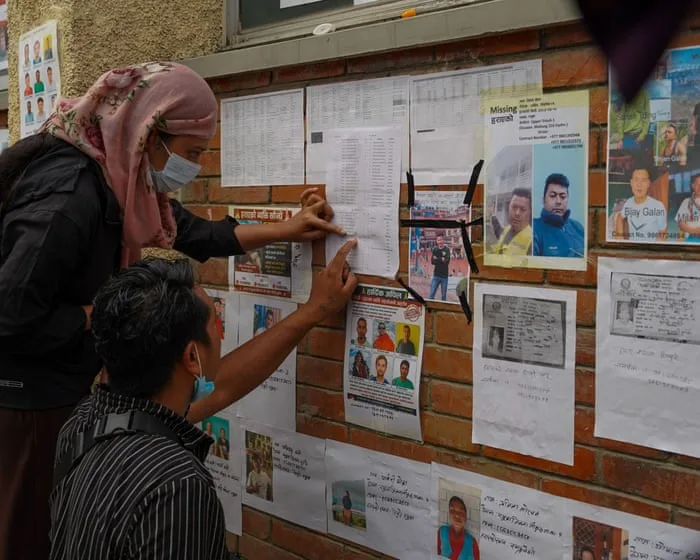
The walls of a teaching hospital are filled with pictures of unidentified victims as authorities collect DNA samples and plan burials before morgues fill up
S ome of them are young, some old; most of them appear to be men. Some of them could be sleeping, except for the mud that covers their bodies. Some, it seems, would be impossible to recognise even if you knew them well.
Every few hours Nepalese authorities hang pictures of the deceased, who have not been identified, on a wall at the back of a teaching hospital in Kathmandu.
Saluja, a young woman who did not give her last name, stood among a group of more than 100 people watching. Her cousin, 31, was not on the wall that day.
As she speaks, some in the crowd take videos to send to other relatives; they stand around comparing them, trying to work out whether the person in the photo is their loved one. The bodies have a piece of paper lying on top of them, showing which district they were found in, with a number to contact.
“My cousin is missing,” Saluja says. “He worked in a hydro power plant … Since the flood, we have not been able to contact him.
“It was the first area to get affected, so we really don’t know. But we are hoping for the best.”
While she talked, her other cousin, his older brother, was on the plane flying home from Australia. Since Wednesday, Kathmandu has swelled with international visitors – not tourists but people looking for their loved ones.
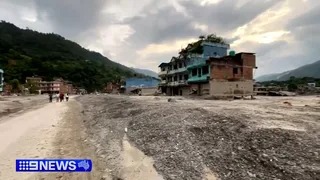
The Nepalese government has deployed about 15,000 personnel – from the army to the police – to move up the valley and into the areas decimated by the flood, hoping to find survivors.
While they battle arduous search conditions – areas completely cut off, roads destroyed, bridges washed away and a new lake threatening to burst – loved ones from Australia rush to Nepal to be with their families. They come to chase leads and to wait.
“My older cousin, he’s a doctor in Australia, and his wife is a dentist,” Saluja says. “So they both are coming back. They’re going to try with the search and to be with the family as well. They obviously want to be with the family.”
It’s been four days since the glacier collapsed high in the Himalayas, sending a wall of water, ice and mud down to destroy everything in its path.
The number of people killed has risen to 669, with nearly 3,000 people lost. On the Chinese side, more than 550 people are unaccounted for. Forty-one Australians are still missing.
On Saturday, New South Wales man Michael Keats was confirmed to be one of them. He had reached the Nepal-Tibet border just moments before disaster struck, his family said in a statement.
5News aggregated this summary from the outlet’s public feed. The full article, with all the context, is on www.theguardian.com — the content belongs to The Guardian Australia - World.