Meet the gig workers helping train robots to do our dishes
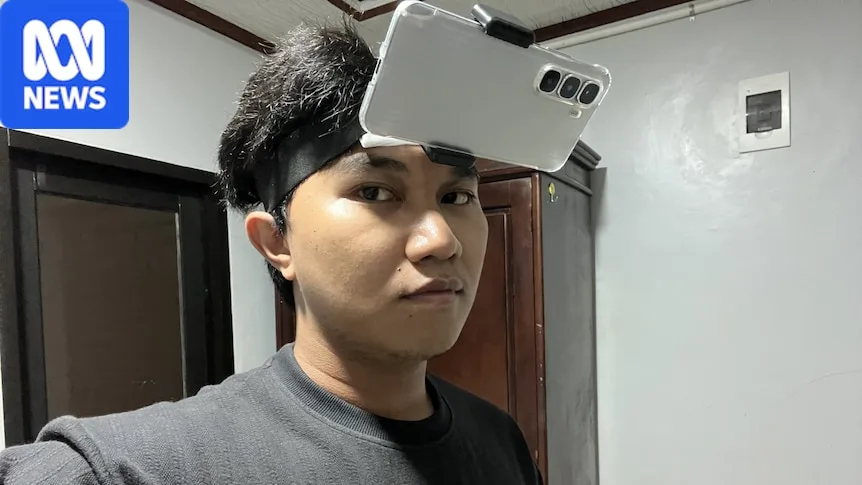
Mohamad Dunggio recently strapped a mobile phone to his head and recorded himself doing his dishes over and over again for four hours.
"I think it's OK because I exchange my time to earn money," said the 23-year-old from Gorontalo on Sulawesi in Indonesia.
Mr Dunggio is one of the thousands of gig workers around the world feeding the robotics industry's insatiable demand for training data.
Since April he has been earning extra cash making "egocentric training" videos, used to teach robots how to do things like household chores.
Egocentric training data is sensor or video recordings made from the perspective of the person doing the task, often captured with a head or chest-mounted camera with a focus on keeping the subject's hands in the frame.
Mr Dunggio said he was paid by three companies from Argentina, India and the US between $US3 ($4.22) and $US10 an hour to record himself performing tasks like dishwashing, cleaning, cooking, making the bed, ironing, folding clothes and sweeping.
"I think it's a good thing to do because you don't have to have any experience," he said.
As the recent World Humanoid Robot Games in China demonstrated , robots have been advancing in literal leaps and bounds in recent years.
But the dream of a multi-function humanoid robot that can move around the home efficiently and reliably taking on a variety of domestic tasks has so far proven elusive.
Dana Kulić, a robotics professor at Monash University, said that for robots to navigate the huge variety and complexity of people's homes they needed to learn how to observe and react to their environments.
"Even if the task is just to fold the laundry, or wash the dishes, every person has a different set of dishes. Then the place where [the clothes] should be folded looks different," she said.
Professor Kulić said robotics researchers were using egocentric data in a way similar to how generative AI researchers taught large language models (LLMs) like ChatGPT to predict the next word or letter in a sentence.
While egocentric data produced by actual robots, teleoperated by a human, tended to be more relevant, human egocentric data was cheaper, easier and could provide a much-needed variety of scenarios, she said.
The workers producing the data now include entire factories in South Asia , house cleaners in the US and home delivery drivers .
5News aggregated this summary from the outlet’s public feed. The full article, with all the context, is on www.abc.net.au — the content belongs to ABC News Australia - Top Stories.