Dalaroo cracks geological code to Greenland rare earths
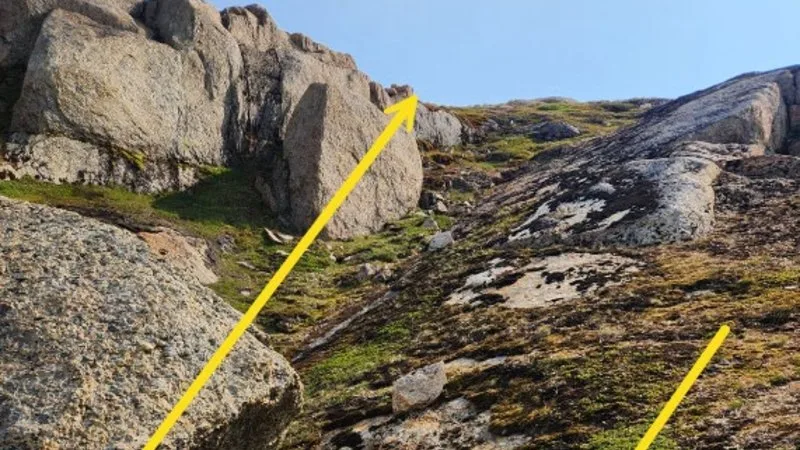
Dalaroo Metals has laid down a detailed geological blueprint of its 100 per cent-owned Blue Lagoon rare earth elements project in southern Greenland, with a mapping program defining the principal structural architecture that appears to control mineralisation in the area.
The company says the work, which involved collecting 354 structural measurements, has identified consistent orientations for quartz veins and pegmatites that show strong similarities to the structural setting of Amaroq Minerals’ adjacent Ilua rare earth pegmatite discovery, which features a hefty five kilometres of strike.
Dalaroo’s mapping program identified a dominant fault set that aligns with the elliptical shape of the Blue Lagoon intrusive complex, in addition to a second fault set that creates a widespread structural network across the project. Management believes this network has created the crucial plumbing for mineral-rich fluids to flow into the Blue Lagoon basin.
The fresh work also identified far-reaching alkaline intrusive and altered rocks, important for their ability to concentrate rare earth elements, including granites, syenites, aplites and pegmatites. Extensive fenitisation, a type of alteration caused by these alkali-rich hydrothermal fluids, was also mapped, suggesting the presence of a big, chemically evolved intrusive system.
The company’s source-to-sink exploration model appears to have been significantly strengthened by the latest mapping. Dalaroo believes the heavily weathered Larvikite, a coarse-grained igneous rock at the centre of the complex, is the primary source of the rare earth mineralisation. The Larvikite is enclosed by a ring of harder Nunarssuit Syenite, which forms the high ridges surrounding the lower-lying Blue Lagoon.
The weathering of these elevated, potentially rare earth-rich intrusive rocks is believed to have transported material into lower-lying basins around the lagoon, where natural traps may have allowed the sediments to accumulate and potentially concentrate the mineralisation.
Multiple generations of intrusive rocks were mapped, including dolerite dykes that form deep valleys and canyons, along with extensive shallow-dipping aplite sills that can be traced for several kilometres. Two sets of amazonite-bearing pegmatites were also identified, which management says provide additional prospective corridors for rare earth minerals.
Dalaroo Metals chief executive officer John Morgan said: “The 2026 mapping program has delivered an important step-change in our understanding of the Blue Lagoon Rare Earth Project. The collection of 354 structural measurements has allowed us to move beyond simply identifying prospective rocks and begin defining the structural architecture that may have controlled the emplacement of REE-bearing pegmatites, felsic intrusions and hydrothermal fluids. We now have a much stronger geological framework with which to interpret our geochemical results.”
In tandem with its structural mapping program, Dalaroo has also collected more than 200 rock-chip, stream-sediment and surface-sediment samples, which have now been dispatched for multi-element assay analysis.
5News aggregated this summary from the outlet’s public feed. The full article, with all the context, is on www.theage.com.au — the content belongs to The Age - Home.