The ‘miracle house’ that survived Nepal’s floods
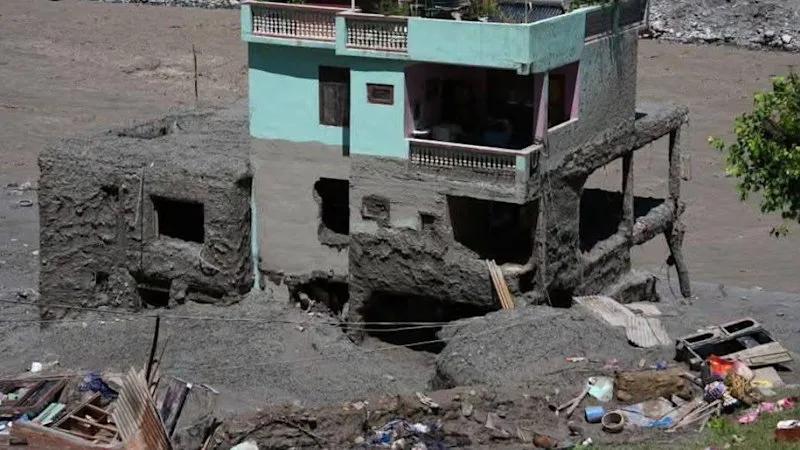
Dhunge Bazaar, Nepal: For some, it has become known as the “miracle” green house. For others arriving to stare in wonderment and take selfies, it is simply “the viral house”.
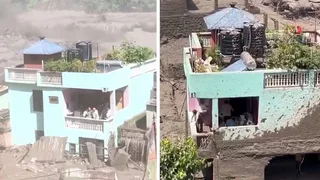
When a ferocious torrent of water, mud and debris swept away everything in its path in Nepal last week, it created a whirlpool of destruction around the Pyakurel family home in Dhunge Bazaar. A video that spread far and wide on social media showed the family helplessly looking down from their third-floor balcony at the angry waves, barely fluid, threatening to overwhelm them.
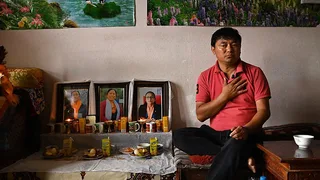
Chhatra Bahadur Pyakurel, 67, had just returned from taking his grandson to the school bus when the floods – caused by a massive glacier collapse in the Himalayan region between Nepal and Tibet – reached their home.
For more than an hour, the family could only watch the carnage around them – first from the balcony, and then having climbed to the roof, as the wall of water and debris grew deeper and wilder.
“At first we did not know what would happen or whether we would survive,” Pyakurel said. “But after some time, we realised there was nothing more we could do. Our lives were in the hands of the almighty God, whether he would save us or let us drown.”
“The only thought that kept troubling me was about my grandson, who had already left for school. I kept thinking: ‘If we all die, who will look after him?’”
Online images of the house – still standing, alone amid a wasteland of mud and debris – went viral. Days after the devastation, as the road in front of the house was partially reopened and traffic slowly returned to Dhunge Bazaar, visitors climbed the ridge for a view of the house and river, now calmer, its flow still muddy.
The house has its own pinpoint on Google Maps as a “flood-proof” attraction.
Pillars and walls of the first two storeys remain. On the third-storey balcony, the washing machine remained, along with a pile of laundry. The roof – with its water tanks, a solar water heater, a small family temple and many tall plants – looked neatly intact.
The house has become one of the rare stories of survival amid a grim picture of devastation, the extent of which grows daily. The death toll in Nepal exceeds 1200, with almost 4000 more people still missing, and hundreds more remaining unaccounted for in Tibet.
Missions complicated by continuous rain –and entire towns covered in the kind of soft mud that makes helicopter landings difficult – have rescued more than 11,000 people. Thousands of whom are in temporary shelters.
In the surrounding Nuwakot district alone, at least 1200 homes have been destroyed and more than 1000 others partially damaged.
Communications remain a major issue in a country with difficult terrain. Dozens of bridges have been wiped out and stretches of road, including the one just beyond Dhunge Bazaar, destroyed.
Bishu Mani Rimal, 45, who was among the crowd staring at the surviving house, lives 4.8 kilometres downstream, where the torrent of water had slowed slightly.
5News aggregated this summary from the outlet’s public feed. The full article, with all the context, is on www.smh.com.au — the content belongs to Sydney Morning Herald - World.