Japanese artist Yayoi Kusama, who filled the world with polka dots, dead at 97
Yayoi Kusama, one of the world’s most celebrated and best-selling artists, has died age 97, according to a statement on the artist’s official website.
“It is with profound sorrow that (we announce) the passing of Yayoi Kusama at a hospital in Tokyo on August 14,” read the statement, posted on Thursday.
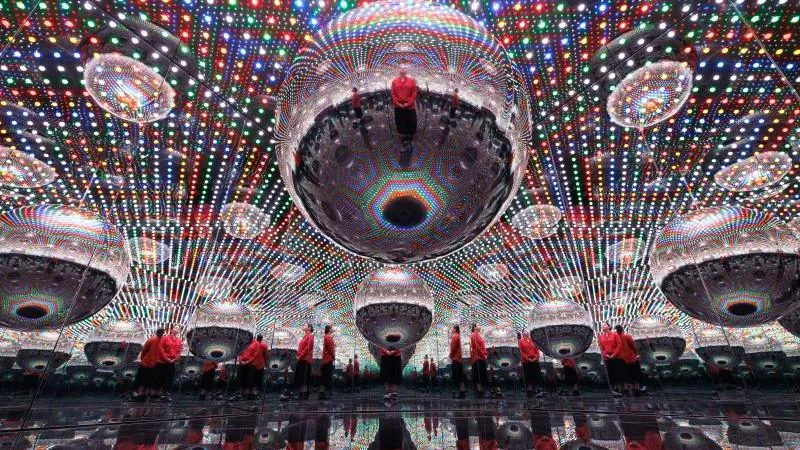
Kusama was, by the time of her death, one of contemporary art’s most popular and commercially successful figures. Her famous Infinity Mirror Rooms, large-scale installations that immersed audiences in endlessly repeating reflections of colour and light, attracted millions of gallery visitors.
Her distinctive pumpkin sculptures and polka-dot paintings, meanwhile, generated millions of dollars in auction revenue.
But the global recognition of her work in later years was made all the more remarkable by the difficulties she overcame to achieve it, namely childhood trauma, mental illness and years of relative obscurity.
Born into a dysfunctional and abusive household in 1929, Kusama spent much of her childhood in a military factory sewing parachutes for Japan’s imperial army during World War II. She was, by this time, experiencing vivid hallucinations, which flooded her world with the polka dots that would later characterise her work.
Despite briefly studying the modernist “nihonga” painting style at art school in Kyoto, Kusama had little formal training — or apparent interest — in Japanese art traditions. From the earliest stages of her career, she instead experimented with abstraction and the repeated dot patterns seen in her celebrated Infinity Nets paintings. Encouraged by a letter exchange with American artist Georgia O’Keeffe, and disillusioned with life in postwar Japan, the 27-year-old moved to America in the late 1950s, arriving in Seattle before relocating to New York amid the genesis of the pop art movement.
She proceeded to turn the city’s abstract impressionist tradition on its head in a storm of dots, flowers and phallic protrusions, producing a significant body of work that included not only paintings and sculptures, but surreal works of film, literature and performance art.
In keeping with 1960s counterculture, Kusama staged “happenings” in which she transformed naked bodies into dotted canvases. She also famously sent an open letter to US President Richard Nixon in 1968 offering to have sex with him if he stopped the Vietnam war. “Let’s forget ourselves, dearest Richard,” she wrote, “and become one with the Absolute, all together in the alltogether (sic).”
Nixon appears not to have taken up the offer. (The war did not end until 1975, with the Fall of Saigon.) But such episodes demonstrated that, although Kusama’s work was full of joy and colour, she was unafraid to address key battlegrounds of the day: gender equality, gay rights and the anti-war movement.
The art establishment often drew on, if not directly copied, Kusama’s work. But it never fully embraced her.
5News aggregated this summary from the outlet’s public feed. The full article, with all the context, is on 7news.com.au — the content belongs to 7NEWS Australia.