Tesla Roadster revealed with flying tech, 0.8sec 0-100km/h sprint time
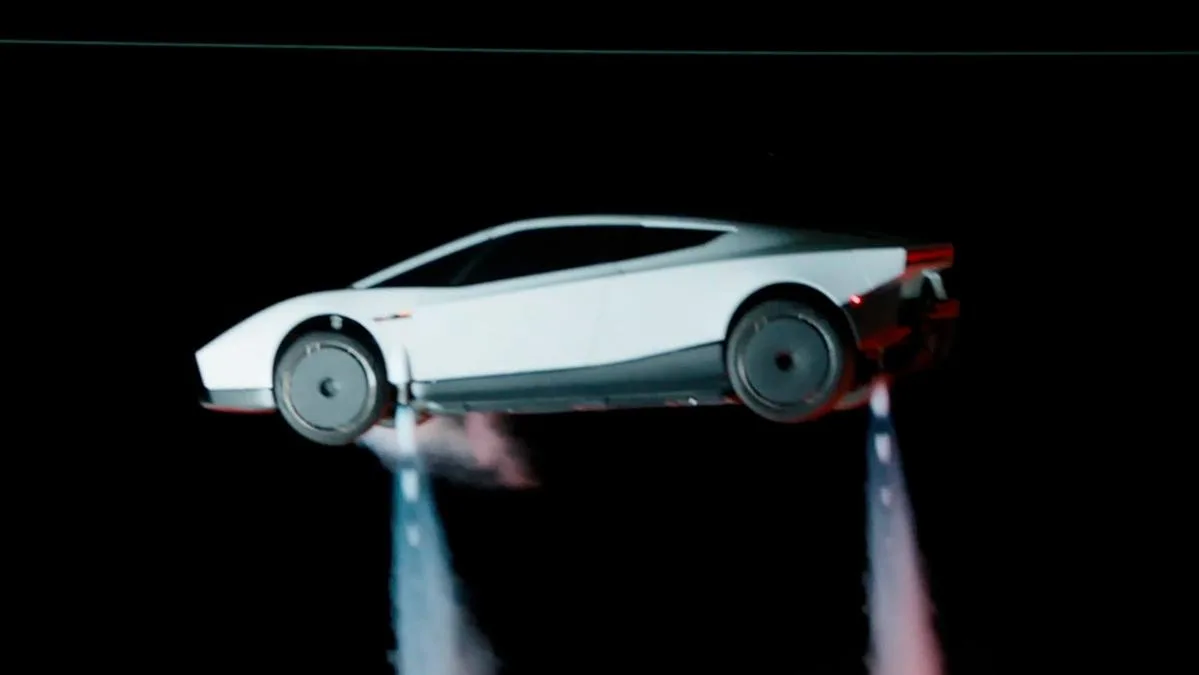
The long-awaited second-generation Tesla Roadster has finally been scheduled to go into production, in 2028 – over a decade after it was revealed in concept form – and the US electric vehicle (EV) maker has demonstrated the latest iteration of its electric sports car in a series of flying stunts at the SpaceX test centre in McGregor, Texas today.
Tesla CEO Elon Musk, who is also the founder and CEO of SpaceX, said the vehicle will be capable of accelerating from 0-60mph (97km/h) in less than one second. A demonstration run shown during the livestreamed event recorded a claimed time of 0.81 seconds.
That’s quicker than Tesla's original acceleration claim for the second-generation Roadster, first revealed in 2017, when Mr Musk promised a 0-60mph time of 1.9 seconds, a top speed exceeding 400km/h, and a driving range of approximately 1000km.
Tesla is now targeting a top speed of 230mph (370km/h), but Mr Musk today said the new Roadster has “got to crack halfway to the speed of sound” of Mach 0.5, which equates to about 383.5mph (617km/h).
🚘 Don’t just read about your next car. Find a great deal with CarExpert.
“This is not an autonomous car, it is the last – well, it is technically autonomous for this demo to make sure we don’t kill anyone – but this will actually be long-term the only manually driven car that Tesla makes,” Mr Musk said.
The demonstration included a series of jumps in which the Roadster used thrusters fed by ultra-high-pressure compressed-air tanks to ‘fly’ in front of the live audience.
It jumped a collection of parked Teslas and made a controlled landing after driving up a Hot Wheels-like ramp.
In top-spec form there’s also a fan system designed to suck the vehicle to the ground, similar in principle to the technology used by Jack Brabham’s BT46B Formula 1 car in 1978. Mr Brabham withdrew that car after its sole grand prix outing, which it won.
The Roadster’s fan system operates in Track mode, which also lowers the suspension.
“We have a suction, a fan suction system on the bottom of the car that can pull up to two Gs in order to make the car go upside down," explained Tesla’s vice president of vehicle engineering, Lars Moravy.
The Roadster’s active aerodynamics include a large rear wing that extends according to the downforce required, said Mr Musk.
Tesla claims the thruster system can generate more than 80kN of thrust, while the Roadster is said to be capable of cornering at 2g.
“Now you might say, like, how often do you want to stick upside down in a car?” said Mr Musk.
5News aggregated this summary from the outlet’s public feed. The full article, with all the context, is on www.perthnow.com.au — the content belongs to PerthNow.