NASA scientist's chance Moon discovery reveales once in a lifetime crater
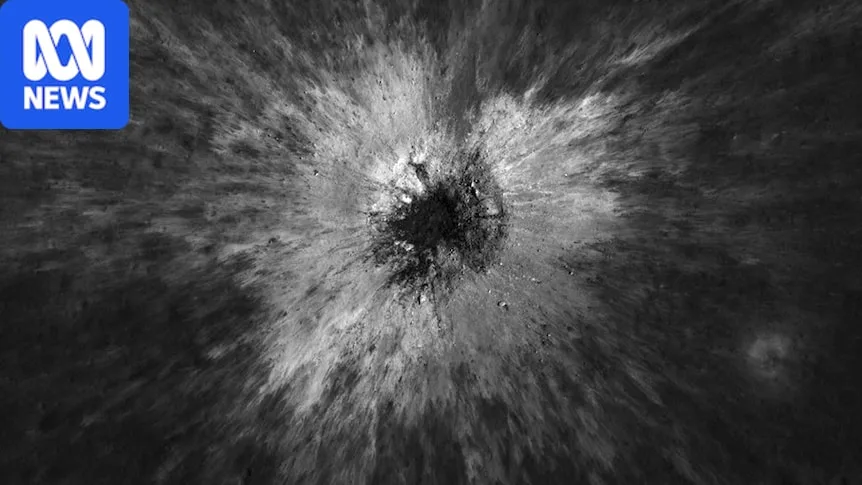
When NASA scientist Robert Wagner first noticed a "bright spot" on the surface of the Moon in 2025 he was unaware he had just discovered the largest, newly-formed crater ever found in the solar system.
Measuring wider and about as deep as the Roman Colosseum, researchers believe the crater was formed after a powerful surface impact just over a year before humans noticed it.
Its discovery revealed an impact event NASA says only happens every 132 years, and which scientists hope will become critical to informing future research.
On October 24 last year Mr Wagner was examining routine data quality reports and maps generated from NASA's Lunar Reconnaissance Orbiter (LRO).
The LRO has circled the Moon for more than 17 years, mapping its topography, surface composition, temperature and radiation environment, NASA says .
Through its work, scientists are able to identify changes to the Moon's surface by comparing high-resolution "before and after" photographs taken by the LRO.
When Mr Wagner spotted "an unusually large bright spot circled by a dark halo", he said he immediately knew it needed further analysis.
"I just stopped, dropped everything, and started looking into what that spot was," he said.
The discovery became known as the McGetchin crater, named after pioneer lunar scientist Tom McGetchin.
It measures 222 metres across and 43 metres deep, which is three-times bigger than the previous record holder found by the LRO a decade ago.
Researchers say they believe the crater was formed between April 11 and May 22, 2024, as a result of a comet or asteroid strike the size of a three to six-storey building.
The LRO's numerous crater discoveries since its launch in 2009 shows the top two centimetres of the Moon's surface soil is being overturned by ejected material every 80,000 years — faster than previously thought, scientists say.
In addition to taking photographs of the Moon, the LRO also has instruments that pick up variations in temperature that can highlight shifts in the lunar surface.
In examining an area surrounding the McGetchin crater, researchers uncovered a 6.5-kilometre patch that was marginally cooler at night.
5News aggregated this summary from the outlet’s public feed. The full article, with all the context, is on www.abc.net.au — the content belongs to ABC News Australia - Top Stories.