3D scans of Tasmanian tiger’s skull reveal it had crocodile-style snapping jaws
Some 90 years after the death of the last documented thylacine – better known as the Tasmanian tiger – the species remains a global symbol of human-made extinction.
The carnivorous marsupial fell victim to 19th-century colonists’ perception that unfamiliar creatures were primitive, vermin-like imitations of more familiar European animals.
The species was later exterminated due to sensationalist claims that it was a ferocious, wolf-like predator of sheep.
However, our new study , published in Nature Communications, suggests the thylacine defied the colonialists’ assumptions in every way.
It was unique among modern predatory mammals by subduing its prey with high-impact snaps of slender, oversized jaws.
Our focus was on one of the most widely cited cases of evolutionary convergence – the dog-shaped skull of the thylacine, which inspired its species epithet cynocephalus (“dog-head”).
This is a striking similarity as thylacines are separated from dogs by more than 120 million years of evolution.
So we set out to understand how deep the similarity really goes.
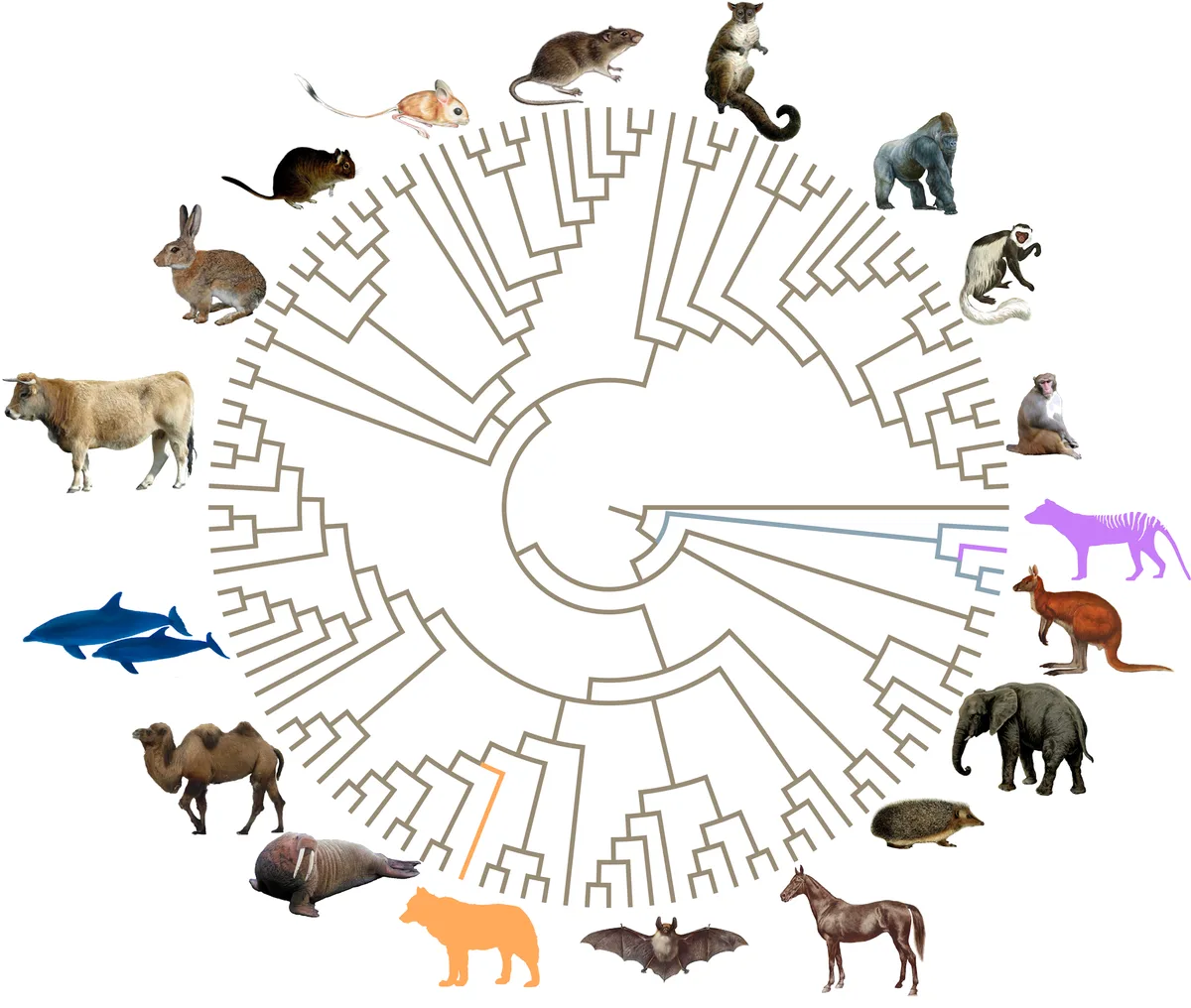
Overview over the mammalian tree of life with thylacine in pink and wolf in orange.
Modified from work by OrthoMaM: A database of orthologous genomic markers for placental mammal phylogenetics.
Ranwez et al. (2007) , CC BY-SA A massive head with a flimsy face We used 3D shape analysis to compare scanned thylacine skulls from museums around the world with those of other predatory mammals.
This revealed that different regions of the thylacine’s skull resemble those of several other animals.
The thylacine’s long and thin snout looks pretty fragile, most like that of small foxes and jackals.
By contrast, the back of the thylacine’s skull resembles that of wolves, dingos and dholes (also known as the Asiatic wild dog).
5News aggregated this summary from the outlet’s public feed. The full article, with all the context, is on theconversation.com — the content belongs to The Conversation Australia.