Xi under fire as cracks widen in China
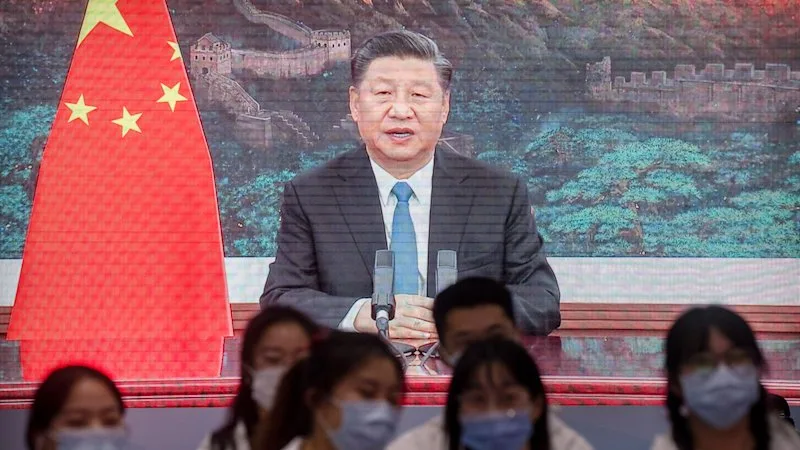
Those assessments of the artificial intelligence rivalry appeared in US publications recently, and Xi Jinping will be pleased to have them in the air as he arrives in Washington this week for a state visit. Under Xi’s leadership, China has made huge strides in developing the most consequential technology of our times. What will be less discussed is that he is also the leader of an economy in its worst shape in decades .
Economists in China – even those closest to the state – have openly warned that the government is pouring too many resources into a technology that creates relatively few jobs, while doing too little to save the broader economy.
And it’s an economy in crisis: The country’s youth unemployment rate, excluding students, reached 18.9 per cent in August. Consumers are not spending. During the first half of the year, domestic car sales fell markedly 20 per cent from a year earlier, and housing sales fell another 14 per cent, adding to years of decline. The country is in a deflationary spiral.
This summer, the economists’ warnings became a chorus. Li Daokui, a former adviser to the country’s central bank and a professor at Tsinghua University, said in July that China’s economy was “running too cold.” Its booming high-tech sectors, he said, could not lift the larger base.
At a forum in June, Liu Shijin, another former adviser to the central bank, proposed raising basic pension payouts from $US30 to $US150 per month for rural residents to shore up consumer demand.
At the same forum, Huang Haizhou, an adviser to the central bank, said Beijing must foster mild inflation and corporate profitability before sustained technological advancement could occur. “A country mired in deflation cannot achieve technological innovation,” he said.
The economists’ comments were earlier reported by Bloomberg and Chinese media.
The exact amount of government support for artificial intelligence is difficult to know. Stanford’s AI Index Report noted that state-initiated investment funds deployed an estimated $US184 billion ($258 billion) into AI firms from 2000 to 2023.
Last year, Xi instructed the government to use every tool at its disposal, including tax breaks, government contracts, financing and access to infrastructure, to advance AI. And, according to Bloomberg, China is preparing to spend around $US295 billion over the next five years to build data centres across the country, which will be operated by state-owned firms.
The Chinese economists’ bluntness was revealing, as was the timing, just before the regular midyear meeting of China’s ruling Politburo. They have been warned against sounding too pessimistic, and some have been censored or silenced for doing so. That these establishment figures were speaking so starkly – right before the leadership was about to calibrate economic policy – suggested how alarmed they had become.
Taken together, their message was clear: the Chinese economy was in trouble, and an AI-centred allocation of resources could prove costly to ordinary people’s livelihoods and the country’s economic future.
The leadership gave their warnings little heed.
5News aggregated this summary from the outlet’s public feed. The full article, with all the context, is on www.theage.com.au — the content belongs to The Age - Home.