With delight and schadenfreude, Ash Flanders’ Commentary skewers the male artistic genius
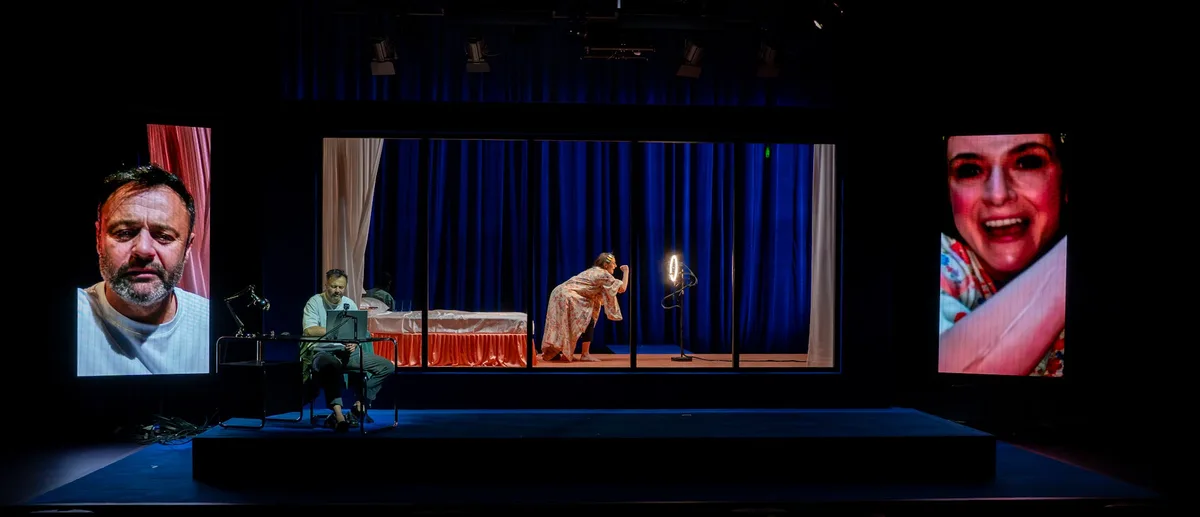
Matt Byrne/STCSA Bold doesn’t even begin to describe Commentary, the new play written by Ash Flanders: an acerbic flaying of public and private personas.
Middle-aged film academic and former film maker Nick Atkinson (Gyton Grantley) is preparing the director’s commentary for a retrospective screening of his one film, Low, in the city’s film festival.
Made in his youth with his creative partner, Hamish (spoken of, but never seen), the once much-lauded film stars Saskia (Kate Cheel) playing a 14-year-old girl who is pursued by an older male, played by Hamish.
But the real-life predatory behaviour of Hamish towards another young woman means the film goes from new classic to non-grata, and Nick’s film career is over.
Flanders’ delicious writing gives us characters turned inside out to show the gory visceral underside of human behaviour when confronted with their own lies and failings.
It exposes the changing morality of what is accepted in “getting the shot” or creating art, alongside what is accepted in male behaviour in relationships.
A sure directorial hand Petra Kalive directs a dream cast in this enjoyable and mercilessly sharp drama – part satire, part stark realism, with an excellent eye for revealing the duality and public vs private personas of each character and situation.
Mediated conversations abound: the ever-present auteur’s voice-over commentary of events, live zoom calls projected onto large side screens, filmed images, podcast interviews.
We are constantly seeing the way these characters package and present themselves and their version of events.
Kalive’s sure hand and the constant presence of the “tech” staff, played by the actors and the play’s stage management team, as observers to events, is wryly placed and gives a cheeky nod to the idea of audience.
Shifting, shattering power dynamics Grantley revels in the likeable, shambolic, charismatic anti-hero, shifting mercurially between opinionated charmer, slightly hopeless negotiator, defensive man of privilege and messy drunk.
He effortlessly draws us into Nick’s version of events in a finely nuanced portrayal.
Nick is a man that is all-too familiar in arts, academic and public life, and Grantley lets us see him as Nick sees himself: the sun around which women orbit.
As the play progresses, the women chip away at the story he has created for himself and we watch the power dynamic shift and shatter.
5News aggregated this summary from the outlet’s public feed. The full article, with all the context, is on theconversation.com — the content belongs to The Conversation Australia.