Babies review – Anna Kendrick and Seth Rogen embrace childlessness in breezy comedy
Toronto film festival: To be a parent or not to be a parent is the question propelling this often insightful yet largely run-of-the-mill riff on a Judd Apatow movie
It’s a question still casually and routinely asked to couples everywhere regardless of familiarity, one that many fear and some feel actively offended by: are you guys gonna have kids?
Despite living in an age where we’re supposedly more accepting of people who make choices that don’t conform to whatever dusty old standards our parents and their parents had to live by, there’s still an odd regressive judgment attached to those who dare to say no or even maybe. There’s the sad tilt of the head and maybe a “but you’d make such great parents” on top, as if either would make a difference to one of life’s biggest decisions. It’s a question that writer-director Lauren Miller Rogen knows all too well and as the wife of Seth Rogen , it’s one that has an answer that immediately becomes a headline .
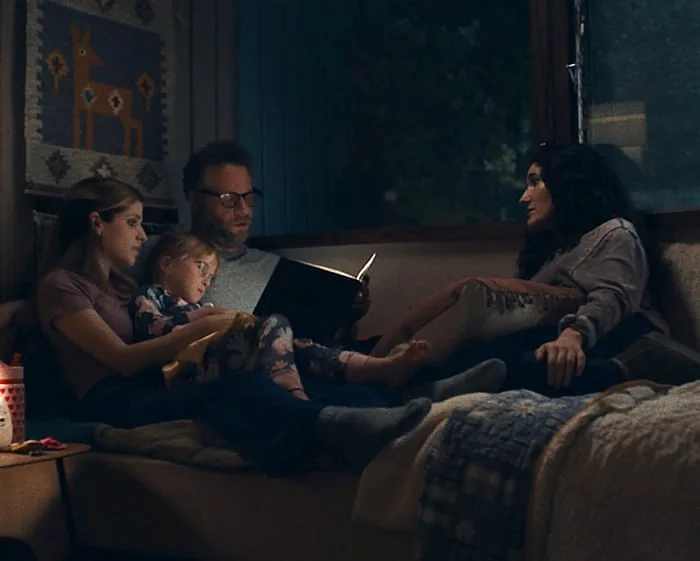
She has used this frustration to fuel Babies, a mostly likable if a little run-of-the-mill comedy about a couple faced with similarly intrusive questioning. She has recruited her husband and paired him with Anna Kendrick , the pair playing the Los Angeles couple of Aaron and Annie. We meet them at a pool party with friends that, as of recent years, has turned into more of a kids’ party. Annie’s voiceover, a rather lazy and inconsistently used device that the film could do without, informs us that she is almost constantly weighing up the pros and cons, laid out as we see her moon after a cute kid before expressing repulsion at them another having a tantrum. It’s creating a gap with Aaron’s friends (who don’t have as much time as he has to delve into the Bosch universe, one of the script’s funnier jokes), but more so with Annie’s friends Becky and Eliza, played by Issa Rae and Kate Berlant , whose lives are constricting, offering less space for her. The decision is both helped and hindered by Aaron’s easygoing nature, a loving husband but one who doesn’t seem to care either way, allowing her to make the choice.
When Eliza leaves her husband ( Dan Stevens ) she invites herself, with daughter Eve (a child Annie actually likes), to stay with Annie and Aaron until they can find a better solution. “Having a kid in the house will push us in a direction,” Annie tells Aaron – although it’s one of many occasions when we can feel Miller Rogen telling us too , as if she doesn’t trust her ability to just show us (too many conversations in the film feel like they have been had for the first time, as if the characters didn’t exist before someone yelled “action”). The couple are then forced, by the film, to see whether having a child around the house will push them closer to or further away the the idea of parenthood.
As Annie and Aaron wrestle with whether or not to parent, Miller Rogen also wrestles what kind of film she wants to be making.
5News aggregated this summary from the outlet’s public feed. The full article, with all the context, is on www.theguardian.com — the content belongs to The Guardian Australia - Culture.