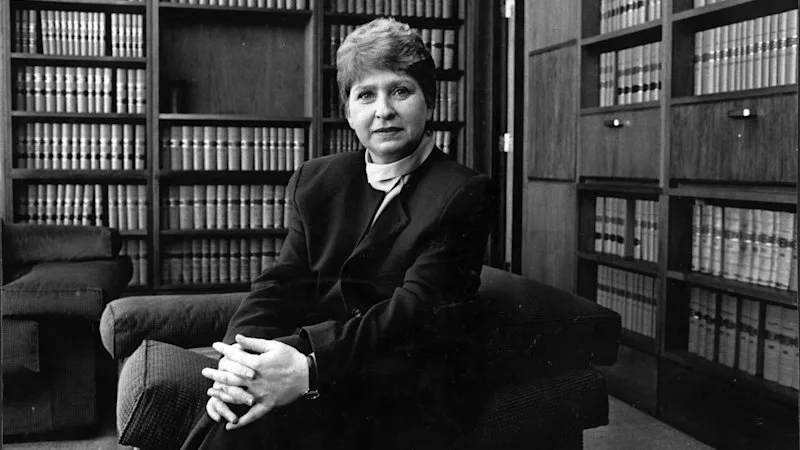
From Moree schoolgirl to High Court trailblazer and human rights advocate
When in 1951 Dr H.V. (Doc) Evatt, then federal opposition leader, stood in the back of a utility in Moree to campaign for a “no” vote in the coming referendum to outlaw communism, he encountered an eight-year-old girl who asked: “Please, sir, what’s a constitution?”
The Doc must have had prescience, or astonishing insight, because he took the child seriously, and after a discussion relating the Ten Commandments to government, he sent her a copy of the Australian Constitution. The little girl, Mary Gaudron, was to grow up to become the first woman appointed to the High Court of Australia and rule on matters relating to that very constitution.
Mary Genevieve Gaudron was born in Moree on January 5, 1943, the eldest of five children of a train driver, Edward Gaudron, and his wife Grace (Bonnie) (nee Mawkes). Mary’s working-class background later would open her up to criticisms that she was “Labor-oriented”. She did have a keen interest in the disadvantaged. But she needed drive, being born in those circumstances, decades before women’s liberation became fashionable. Through her life, Gaudron, feisty and plain-spoken, was to contribute to rectifying most of the problems she was exposed to in her early life, including Moree’s race relations.
Gaudron went to a local convent school, then got a bursary to St Ursula’s, Armidale. One nun recalled her as a “quick-witted girl … determined to make the best of her abilities”. Gaudron achieved a brilliant Leaving Certificate pass, which earned her a Commonwealth Scholarship to study arts/law at the University of Sydney, which she entered in 1959. She took an interest in speleology, the study of caves, and also played the mandolin.
University friends remembered her as “brilliant” or “good fun”. She graduated in arts in 1962 and in February 1963 she married a fellow caver, Benjamin Sidney Nurse. She continued a law course part-time, supporting herself by working as a registration clerk in a legal office.
Gaudron encountered many obstacles. One of her lecturers said she should not take part in a moot court because women were not expected to take the practice of law seriously. But she was scarcely to be put off. Blackacre , the law students’ magazine, paid tribute to “a slight redhead with a temper to match”, and added: “Mary has all the attributes of a thoroughly disconcerting, accomplished debater. She has a keen analytical mind, a magnificent command of language and sheer audacity. Opponents are demolished by a few four-letter words.”
Gaudron gave birth to her first child, Danielle, in 1964 and the following year she topped her final law exams.
Taking out the University Medal, and asked to comment on the award going to a female rather than a male, she said: “The only difference between us is that I sit down to pee!” She lectured for a time on succession law; she got articles despite prejudice among lawyers in favour of male graduates; and she was admitted as a solicitor of the NSW Supreme Court.
5News aggregated this summary from the outlet’s public feed. The full article, with all the context, is on www.watoday.com.au — the content belongs to WAtoday.