Money talks: Why Australia can afford to have the oldest Test team since the 1920s
You've used all of your gift articles. 3 more will become available on the 1st of every month.
The cricket world keeps expecting Australia’s Test team to act their age, and the players keep saying: “Not yet.”
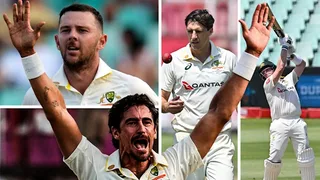
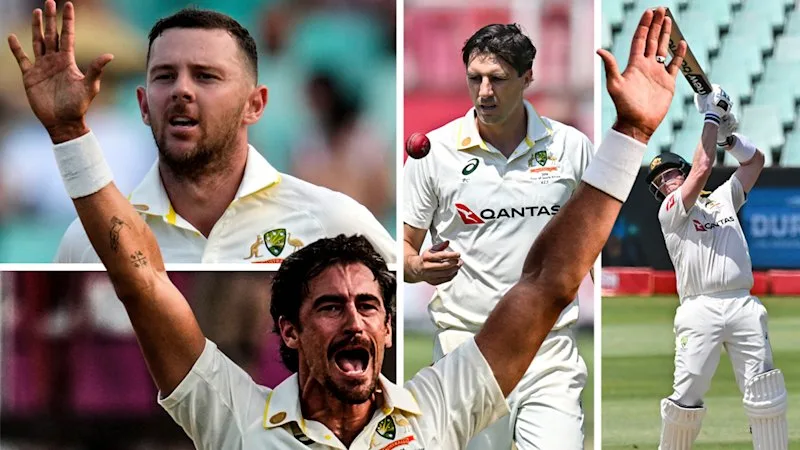
Mitchell Starc’s hairline is the only part of him that looks as old as 36. Patrick Cummins and Josh Hazlewood, injury-free in Durban, bowled with the pace and freshness of men in their early 20s – or better, in their case, given how much of their early 20s they spent rehabbing.
Steve Smith, at 37, may refine his particular personal routines and conclude his restless search for perfection, but only in the distant future.
Young Matt Renshaw, a stripling of 30, saved the day at Kingsmead; a potential 10-year career lies ahead.
History says a team can’t thrive when none of its personnel is younger than 30 – unprecedented – or when its average age, 34.59, is higher than most of its batting averages.
The years overhaul all of us; history needs to be the final winner. But those of us who thought this team would have been timed out by now have been proven wrong.
There may be XI portraits of Dorian Gray in their attics. Or Test cricket’s 150 years might tell a slightly different story about age.
The oldest Test cricket teams were anomalies after the First World War. Australia’s oldest by average age (35.9) was a group who had lost eight years of Test cricket to the conflict, and were compensated with extended tenures in the 1920s.
Their batting leaders were Charlie Macartney (40), Warren Bardsley (43) and captain Herbie Collins (38). Leg-spinner Arthur Mailey, at 40, would have made Nathan Lyon (38) look young. This was also in a time of faster ageing and shorter life expectancies.
Test cricket’s only older teams were their opponents, the England teams of the 1920s spearheaded by Jack Hobbs, who had played his first Test match in 1908 and scored half of his 199 first-class centuries when he was past 40. He still holds the record as the oldest scorer of a Test century: he was 46. Smith would have to go for another decade to match him.
Those post-war teams were outliers. If we want the common thread between the past and today, we have to look at the reasons for careers ending (or not ending), and here is where we find a basic explanation.
Before WWI, it was normal for Test cricketers to play into their late 30s and beyond.
W.G. Grace finally stood down as England captain in 1899 when he couldn’t bend down to field. He was 50. Syd Gregory captained Australia at 42, Jack Blackham at 40. Fred Spofforth, though he played his last Test match at 33, volunteered to come back for Australia a decade later, when he was representing Derbyshire (Australia politely declined). Pre-war English greats Charles Fry and William Gunn played Test cricket past 40. James Southerton made his debut aged 49, a record that remains.
5News aggregated this summary from the outlet’s public feed. The full article, with all the context, is on www.brisbanetimes.com.au — the content belongs to Brisbane Times.