Blade Runners
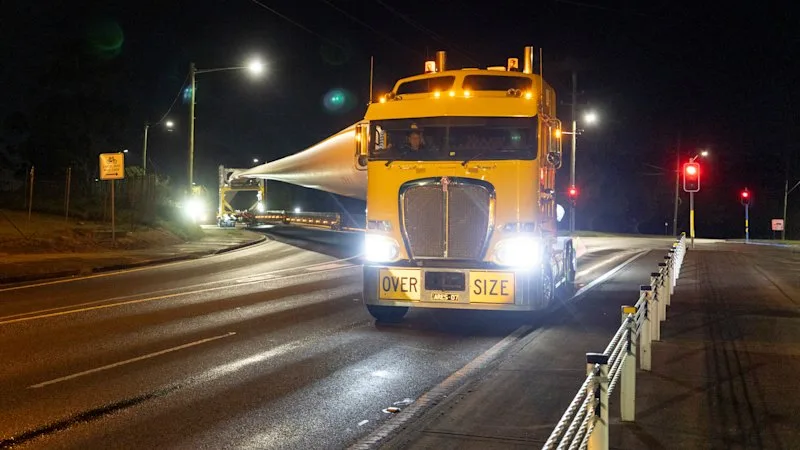
It is just after midnight on a winter morning when we gather at the Port of Newcastle.
In the background coal ships slink by, in the foreground an almost inconceivably vast wind turbine blade lies along the spine of a truck bed like some sort of alien life form strapped to a gurney in a sci-fi film.
It’s so big that it’s hard to fit it all into the frame of your eye from any reasonable perspective. At its tip it tapers to the length of schoolkid’s ruler. Towards that tapered end it has a jagged edge like a cartoon dragon’s teeth, a shape designed to reduce noise as it slices through the air. Peering up at its midsection, you could be looking at a warship’s prow from the ocean’s surface.
A team of transport specialists are making last-minute preparations to move this beast through the sleeping streets of suburban Newcastle and the coal villages of the Hunter Valley, along the Golden Highway to a hillside outside Wellington on the NSW Central Slopes, where it is to be raised upon a tower as part of a Squadron Energy wind farm that will soon be generating enough electricity for about 220,000 homes.
It seems absurd that this thing can be moved at all, let alone along busy roads, but the man in charge of this circus, Steve Spiller, seems impossibly calm. Jovial, even.
Wind turbine blades, explains engineer Dr Rosemary Barnes, are the largest single-component objects that humans regularly either build or seek to move. Artefacts of the modern world tend to shrink as technology advances, but wind turbines, shaped by both economic and physical forces, keep growing.
Longer turbine blades scoop up more wind and generate more electricity with each rotation, says Barnes, who has spent a career designing, building and repairing turbines and blades around the world and now runs a renewable energy consultancy. A dozen huge turbines need fewer gearboxes, less cable and wiring, less maintenance, less concrete and steel to generate as much electricity as dozens of small ones.
As the turbines grow in length, so do the forces exerted upon them. In extreme conditions, a large blade might bend 10 to 15 metres from a straight line. Imagine, says Barnes, a diving board wilting under the weight of a herd of elephants.
“They have to survive that transfer of force hundreds of millions of times over a life of about 30 years. Every time the blade is in the three o’clock position, gravity is bending it one way, and then when it goes into the nine o’clock position, it’s bending the exact opposite way, and it keeps repeating like that as it spins. It’s just like if you bend a paperclip back and forth repeatedly, you know that small load is not going to break it, but you do it enough times, and you get fatigue loading, it is going to break.”
All this means that not only must a blade be handmade from tough, light composite materials, they are stronger when they are crafted in a single piece, rather than disassembled for transport, which brings us back to Spiller and his crew in Newcastle.
The monster they are about to move is 82 metres long and weighs just over 20 tonnes.
The crew is doing last-minute checks on vehicles and equipment.
5News aggregated this summary from the outlet’s public feed. The full article, with all the context, is on www.theage.com.au — the content belongs to The Age - Home.