We discovered rare dinosaur tracks from the Coniacian age near Tumbler Ridge, British Columbia
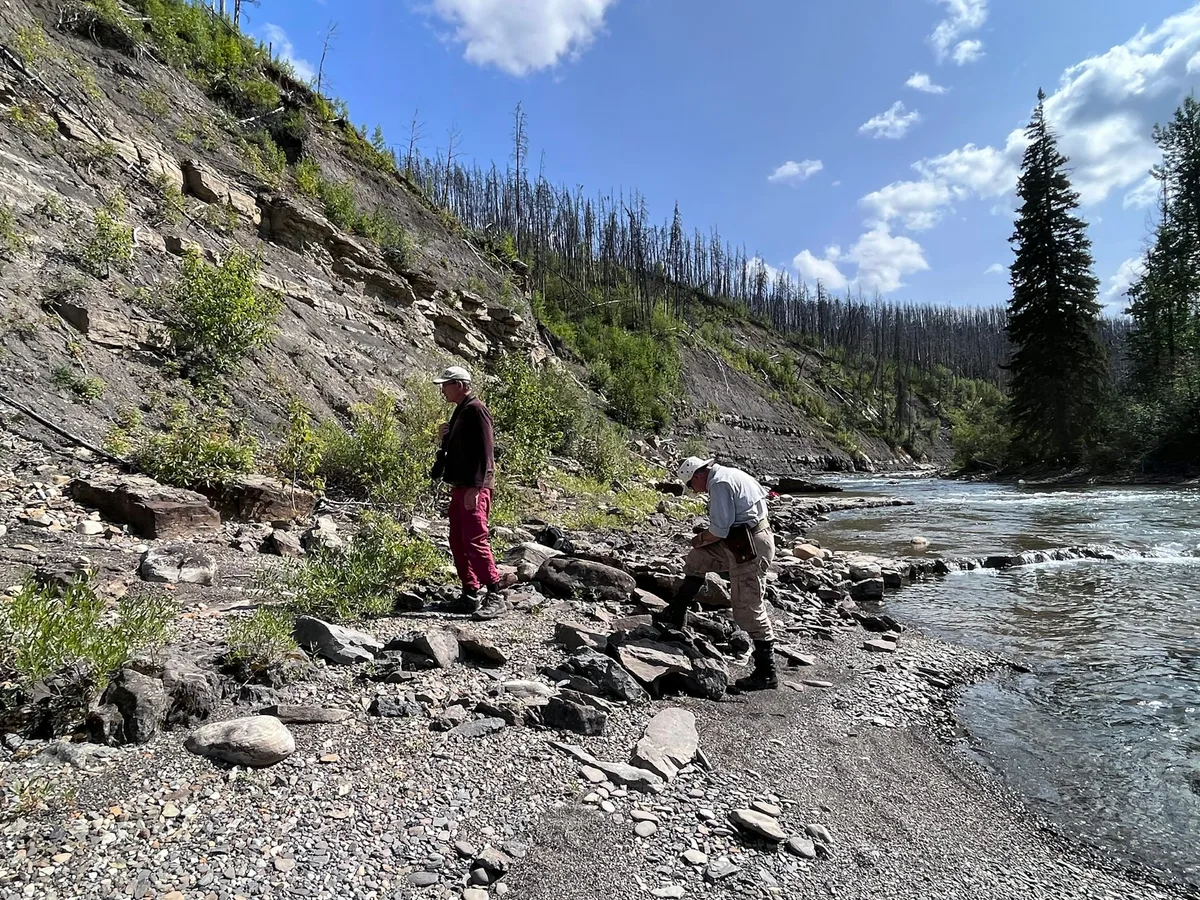
The authors discovered 'duck-billed' ornithopod and carnivorous theropod dinosaur tracks, along with rare rounded tracks with four or five digits, which may belong to ankylosaurian ('armoured') dinosaurs. (Annemarie Plint) Imagine the Western Plains of North America, from Texas to Alaska, submerged under a broad, shallow seaway.
To the west lay the ancestral Rocky Mountains.
To the east were low-lying plains traversed by large, sluggish rivers.
This was the landscape of North America in the mid-Cretaceous period — a geological age with a time span of 105 to 75 million years ago — when the global sea level was around 100 metres higher than it is now .
A high concentration of atmospheric carbon dioxide, due to massive volcanism, created a “greenhouse” climate such that Earth lacked significant polar ice caps .
Alaska and Antarctica enjoyed temperate climates.
The record of dinosaur bones and tracks from this time in North America is sparse, especially from the Coniacian age — a sub-stage of this Cretacious period, spanning 89.75 to 86.5 million years ago.
We have discovered the first Canadian dinosaur tracks from this Coniacian age , in the Tumbler Ridge area of northeastern British Columbia.
One of us, Guy Plint, first noticed these tracks in 1988.
However, the remote nature of the site, best accessed by helicopter, delayed further investigation until 2022 when, together, we were able to begin a more comprehensive study.
The findings were recently published in Historical Biology .
Dinosaurs of North America North America has yielded an abundant record of dinosaurs , both skeletal material and tracks.
Because dinosaur tracks can only be made and preserved in non-marine, terrestrial sediments, most North American tracks are found in sedimentary rocks laid down by rivers that drained the Rocky Mountains.
Their sediment load gradually built deltas and coastal plains along the western margin of the Interior Seaway .
5News aggregated this summary from the outlet’s public feed. The full article, with all the context, is on theconversation.com — the content belongs to The Conversation Canada.