Why fossilized feces from ancestors of modern animals help us understand Earth’s early ecosystems
Long before dinosaurs roamed the Earth, an eruption of biodiversity saw the emergence of the predecessors to modern animals — and an increase in poo.
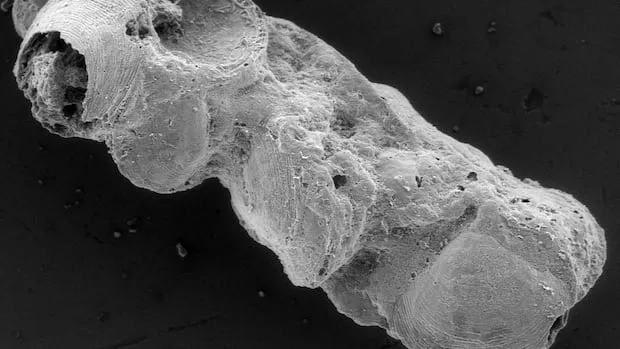
While not the most popular brand of paleontology, a study published last week is shining a light on how the study of coprolites — or poo fossils — helps us understand Earth’s early ecosystems, along with nutrient cycles and animal relationships today.
The paper, published in the journal Trends in Evolution & Ecology , drew on analysis of fecal fossils from the Cambrian period, beginning about 540 million years ago.
Looking at feces records from early worms, invertebrates and mollusk-like organisms, researchers found fecal matter likely contributed to making deep water ecosystems more habitable and nutrients more available during that time — about 300 million years before dinosaurs.
For researchers, the study’s finding that feces appeared in abundance during the Cambrian period is significant for understanding where today’s ocean ecosystems originated.
“Barely anyone that looks at a marine ecosystem thinks there's so much poo floating around that keeps the modern marine ecosystem alive … and that is actually a huge thing,” said Julien Kimmig, a co-author of the paper and head of the paleontology division at the Karlsruhe Natural History Museum in Karlsruhe, Germany.
“You should always have an eye open on what actually drives modern and past ecosystems and potentially evolution.”
For some paleontologists, the research points to how coprolites — fecal matter preserved and mineralized in rock — advance knowledge of not only which animals lived in the distant past but also how their ecosystems worked.
Kimmig and co-author Russell Bicknell analyzed records of several hundred coprolites from 37 deposits around the globe, including some fossils they collected themselves over the years and others within museum collections.
The feces came from a variety of burrowing worms, arthropods, brachiopods and hyoliths (similar to cone-shaped mussels). The earliest fossils were microscopic, but by 15 million years into the Cambrian period, they were close to the size of a rabbit dropping, Kimmig said. Later, they became visible to the naked eye and contained pieces of shell or worm.
Beyond clues about evolution and which animals ate each other, Kimmig said studying coprolites helps understand Earth’s ecology and why the Cambrian Radiation — a rapid appearance of modern animal groups in the fossil record also known as the Cambrian Explosion — brought so much change to ecosystems.
He said ecology might be where paleontology is most relevant to modern society — how past ecosystems adjusted to changes in temperature, oxygen or nutrient levels and biological adaptations might be relevant to what’s to come.
“It is important to not only understand what animals lived through time, but also in which environments they lived and … what led to these different ecological habitats through time,” he said.
“We can take the modern and look at the past … but we can also take the past and actually look at the modern and the future and try at least to model or predict what the future might look like.”
5News aggregated this summary from the outlet’s public feed. The full article, with all the context, is on www.cbc.ca — the content belongs to CBC Technology.