Ancient fossil from China reveals animal-microbe partnerships dating back 550 million years
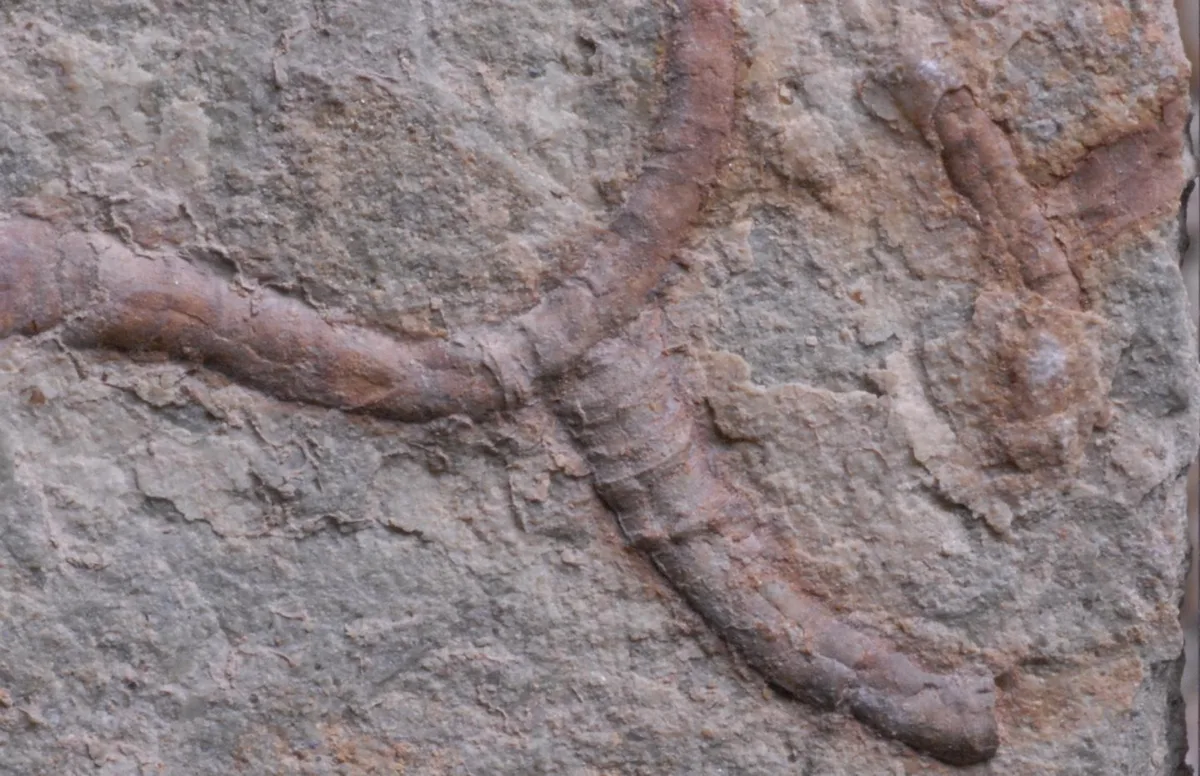
The Conotubus fossil is a small tube-shaped organism that lived around 550 million years ago.
Most likely it was a soft-bodied animal resembling a worm. (Author) , CC BY We often think of microbes as organisms that live around us, like the salmonella bacteria and flu viruses that cause illness.
But some of our most intimate relationships are actually with the microbes living inside of us.
Incredibly, about half of the cells in the human body are actually microbial inhabitants.
Scientific attention to the microbiome has helped us understand how many of them support our health ; for example, by helping us digest food or by supporting our immune system.
Elsewhere in the animal kingdom, microbes forge even more remarkable partnerships with their hosts.
They help generate energy for coral and deep sea tube worms , and break down stubborn molecules like cellulose and lignin within animals as varied as cows and termites.
They even help squid camouflage themselves .
But how long have such partnerships existed? New research led by Zhenfei Wang and Yongbo Peng from Nanjing University, on which I was a co-author, has now found evidence of these close relationships between animals and microbes in a 550 million-year-old fossil from southern China .
Prior to this, the earliest evidence of symbiosis was documented in fossils 100 million years younger.
The Hawaiian bobtail squid uses the light produced by its luminous bacterial symbiont, Vibrio fischeri, as a camouflage. (Wikimedia) , CC BY An ancient tube-shaped fossil Tracing animal-microbe symbiotic relationships back hundreds of millions of years is extremely challenging.
The fossil record is altered, incomplete and biased toward organisms and environments that preserve well.
Even exceptionally preserved fossils rarely retain evidence of the microbes that once lived within an animal.
This fact makes ancient symbiotic relationships very difficult to identify.
5News aggregated this summary from the outlet’s public feed. The full article, with all the context, is on theconversation.com — the content belongs to The Conversation Canada.