The End of Oak Street is a fun — but flat — Spielberg clone
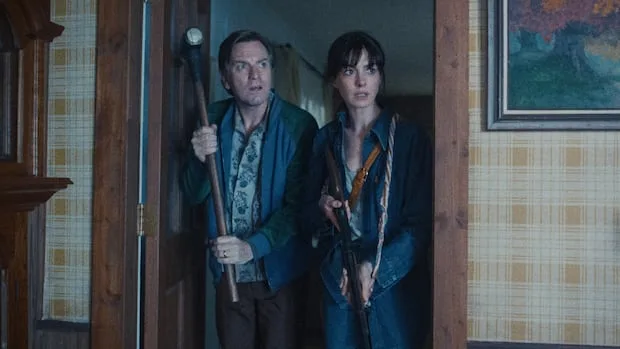
What are you most concerned about as a housewife in 1982? Is it that your kids are off making flirty eyes with their fellow teens or running from the local bully? Is it that your slightly-estranged husband refuses to man the barbecue because he's off to work the second job you asked him to quit?
Or just maybe, the things you're most worried about are the blue lights pulsating around town, the oppressive heat suddenly coursing through the atmosphere — and what looks like a dinosaur tail snaking through your backyard.
Welcome to the world of Oak Street — or as our housewife Denise (Anne Hathaway) and writer/director David Robert Mitchell so forebodingly put it, The End of Oak Street — where a mild-mannered (and deeply unhappy) family's neighbourhood is mysteriously relocated back in time to the late Jurassic period where they're forced to battle both the strange creatures outside their home and all their internal estrangement inside.
As a Spielbergian tale that simultaneously feels ripped straight from a Stephen King book, it certainly does deliver on the vibe.
From aloof but loving, functional-alcoholic father Greg (Ewan McGregor), to forlorn genius elder sister Audrey (Maisy Stella), to boy-next-door little brother Brian (Christian Convery), this Detroit family reads more non-threateningly middle-American than a Leave it to Beaver fourth of July special.
And if we're to believe what everyone and their film-critic mother has decided, it's the perfect recipe for an Amblin-style, B-movie love letter. That, even if it is a bit reductive, Oak Street 's frank and straightforward sentimentality plays like the nostalgic 80s romp yearned for by audiences burnt out on self-serious, trauma-infused films .
If you're looking for a good time at the movies, what could go wrong with a straight-shooting, time-travelling dino flick?
Because while Oak Street is at times genuinely fun and somewhat original, there seems to be something missing from what's been widely crowned as the summer blockbuster we've all been waiting for.
Instead, it's more a going-through-the-motions type film that seems very aware of how classic Spielberg films looked and felt — but isn't necessarily aware of the artistic intent behind them.
It's the exact type of movie you'd expect to find at the centre of a controversy involving an AI-version of the family's dog being used to advertise the film on a fake podcast .
An interpretation of Jurassic Park that begins and ends by looking up through brachiosaurus legs — but features none of the hubris of man, critique of capitalism stuff.
A fascination with the kids-on-bikes-solving-mysteries aesthetics of E.T.
5News aggregated this summary from the outlet’s public feed. The full article, with all the context, is on www.cbc.ca — the content belongs to CBC Arts.