Northern Ontario communites work to contain invasive plant as it spreads
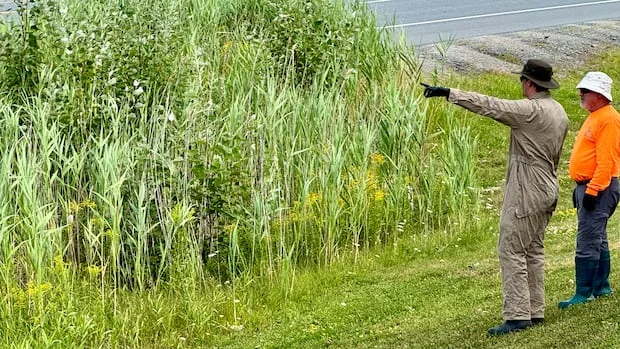
An invasive plant is spreading farther into northern Ontario prompting communities to work on ways to identify and control it before it becomes firmly established.
The Junction Creek Stewardship Committee, a Sudbury-based environmental group, hosted a workshop Wednesday with the not-for-profit company Invasive Phragmites Control Centre to teach people how to identify invasive phragmites and help stop its spread.
Invasive phragmites, also known as common reed, can grow into dense stands that crowd out native plants and disrupt wetland ecosystems.
"It is making its way up to northern Ontario where even in Sudbury we've seen some pretty significant patches starting to take root," said Jayden McGleish, a field supervisor with the Invasive Phragmites Control Centre.
The invasive plant can quickly crowd out native plants such as cattails and bulrushes, and thick patches of it can make it difficult for wildlife to navigate, he said.
"We've seen turtles and frogs really struggle getting through it in the natural ecosystems they live in," McGleish said. "We have found a couple of turtles that haven't made it, which is really sad."
He added that the plant can also affect recreational areas by swallowing up shorelines and preventing access.
Invasive phragmites can also grow along roads and even through asphalt, costing municipalities when the plant ruins drainage areas and breaks up roads, McGleish said.
While the plant is much more established in southern Ontario, it's increasingly being found in northern communities including Sudbury, Sault Ste. Marie, Timmins and Thunder Bay.
Erik Barr, a contract employee with Conservation Sudbury, said Sudbury still has a chance to push the invasive plant back before it grows too far out of control.
"There's a fair amount of it here, and we're at the point where we're starting to control it," Barr said.
One of the first steps is knowing that not every phragmites plant is invasive, Barr said.
Northern Ontario also has a native variety of phragmites, which generally grows alongside other plants instead of forming large, dense patches.
Barr said the invasive variety tends to have wider leaves and thicker stems while the native phragmites plant has a more prominent reddish colour on its stems.
5News aggregated this summary from the outlet’s public feed. The full article, with all the context, is on www.cbc.ca — the content belongs to CBC News.