The Summer Savary Islanders Imported a Ghost
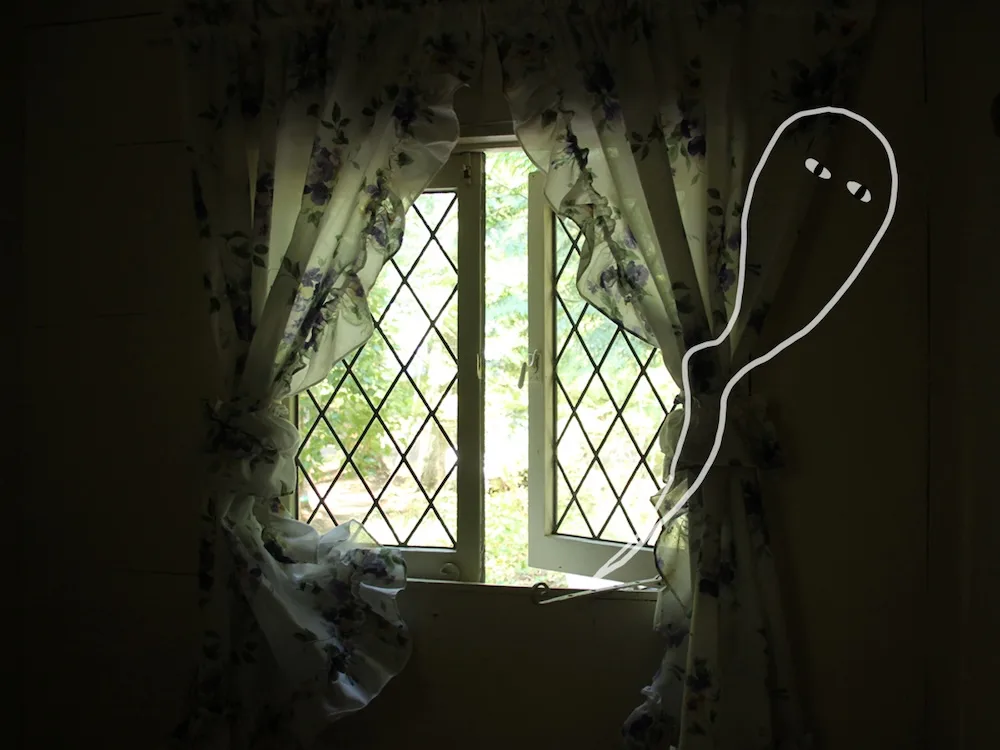
In the summer of 1986, as Michael Jeffery packed his family into their yellow Volvo for their annual jaunt from Vancouver to Savary Island, he added a special delivery: a ghost, sealed in an envelope.
Jeffery, a lawyer known for taking on quirky side quests, had been on a mission to find the right spectral match for his island neighbours’ castle-like cottage. He’d been corresponding with psychic researchers for months.
The Jefferys’ cottage in the θatɛq area of the island was next door to their good friends the Boags.
When Brian Boag quit smoking in the late ’60s, he saved up $700, enough to buy a property on Savary Island and begin building the Princess’s Palace. Brian and Rosemary Boag were both teachers and had time in the summer to add to the palace, an ode to Brian’s infatuation with castles and a nod to his English roots.
With its steep gables, leaded windows and handful of gargoyles, the palace, to Jeffery at least, looked like the kind of place that should be haunted.
So Jeffery sent a letter to the Society for Psychical Research in England, wondering if it would be possible to acquire a ghost. The society wrote back, thanking him for his interest.
“But then said that they were not in the business of providing or supplying ghosts,” his son Stephen Jeffery recalls. The society no longer has a record of their correspondence in its archives, and told The Tyee it’s unusual to relocate a ghost.
“Alleged ghosts are generally place-centred (though well-known ones are often claimed by a number of locations), so it is surprising to hear of one being imported from one country to another,” Tom Ruffles, a member of the society, said in an email.
“What the mechanism would be to allow the transportation of a ghost to happen is a puzzle,” he added.
Soon, however, another letter arrived for Jeffery from England. According to Ainsley Bouveur, the Boags’ daughter and the princess of the Princess’s Palace, a woman named Edwina Longhorn reached out about a lost soul who needed a new residence. (The Tyee was unable to track down a psychic by this name.)
That lost soul was the ghost of Adrian Marsters. Though his name doesn’t appear on a list of the crew, Longhorn told Jeffery that Marsters had been the boatswain on board Capt. George Vancouver’s Discovery. He had, Jeffery was told, been part of the crew who “discovered” Savary Island in 1792. This assertion is repeated in Ian Kennedy’s 1992 book Sunny Sandy Savary .
In 1816, Marsters retired to Devon, England, and lived out his days as a bachelor. It’s said that, after he died, he never left. Folks swore they could still hear his boatswain pipe and said it brought good luck.
By the 1980s, however, Marsters’ home was set to be demolished to make room for a motorway, the letter writer said. Marsters’ spirit, already bodiless, would be homeless too.
Dramatic weather greeted Marsters’ return. Kennedy’s Sunny Sandy Savary describes it as a “frightful, gale-driven night.”
5News aggregated this summary from the outlet’s public feed. The full article, with all the context, is on thetyee.ca — the content belongs to The Tyee.