Instead of making hydrogen, this Canadian company is drilling for it
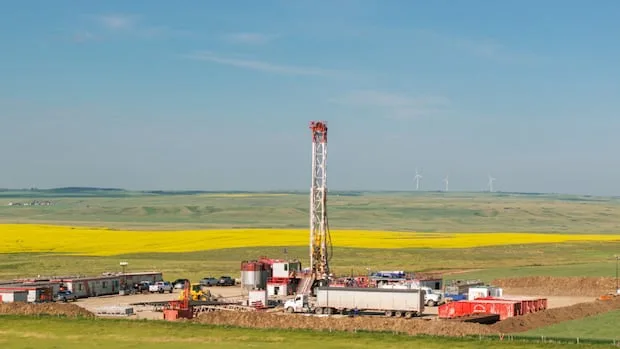
A Saskatchewan company is drilling for hydrogen and trying to prove it can be extracted from the ground at a commercial scale instead of being produced from fossil fuels.
Earlier this month , Regina-based Max Power Mining began drilling its third well at an underground rock formation called the Lawson Complex in southern Saskatchewan.
The company says it could become "the world's first large-scale commercial natural hydrogen system" and the development of a new primary energy source.
Chad Levesque, the company's president and director, said hydrogen is a "critical molecule" for making ammonia, refining petroleum in gasoline and diesel and migrating toward more decarbonized energy sources.
"But we need to figure out a more ecologically friendly way to source that molecule," he said. "And that's where natural occurring hydrogen really comes into play."
But what exactly is natural hydrogen? Why would it be greener than other sources? And if this works, how big a deal is it?
Hydrogen is a gas that can act as a combustible fuel or be fed into fuel cells to generate electricity. In both cases, it reacts with oxygen to generate water as its only byproduct.
Because of that, it has been touted as a good energy source or fuel to cut emissions from hard-to-decarbonize sectors such as transportation and steelmaking .
It's also an important chemical ingredient to make things such as ammonia and methanol and refining petroleum — what most hydrogen is currently used for, according the International Energy Agency's 2026 Global Hydrogen Review .
Hydrogen vs. batteries: Which is winning the race to electrify heavy trucks?
"But we're still using energy [intensive] processes to produce that molecule," Levesque said.
Nearly all hydrogen available for sale (more than 80 per cent) is what's known as grey hydrogen, which is produced from fossil fuels (mostly natural gas and coal) without reducing emissions through carbon capture. Because of that, hydrogen production generated 1,000 megatonnes of carbon dioxide in 2025 — more than the combined emissions of France and Indonesia, the International Energy Agency (IEA) reports.
Green hydrogen — which is produced using renewable energy and generates lower emissions — can be made from a process called electrolysis of water, which uses electricity to split water molecules into hydrogen and oxygen gas. It's much more expensive and "far from being competitive" with grey hydrogen, the IEA says.
In theory, natural hydrogen, also called white hydrogen, doesn't need to be produced through an energy-intensive industrial process. It just needs to be released from underground deposits and captured, resulting in relatively low greenhouse gas emissions.
5News aggregated this summary from the outlet’s public feed. The full article, with all the context, is on www.cbc.ca — the content belongs to CBC Technology.