What is Keystone XL—and why does Trump want to bring it back to life?
U.S. President Donald Trump says he is looking to revive the the Keystone XL pipeline expansion project as part of trade talks with Canada, and after agreeing to pause new tariffs of up to 50 per cent on some Canadian goods for three days while officials try to reach a deal.
Trump made the announcement in a post on his social media platform, Truth Social.
This also comes after Trump in April signed an order granting a cross-border permit to a project that would revive parts of the Keystone XL pipeline.
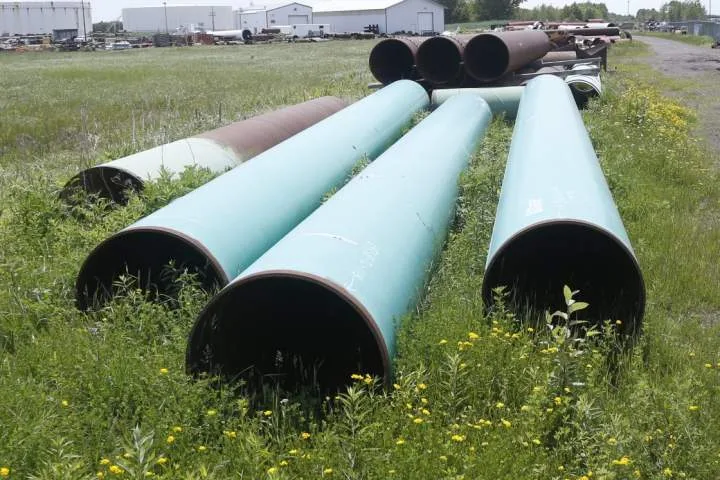
The Keystone XL pipeline project has gone through years of off and on updates based on changing U.S. administrations. Several experts say the Keystone expansion is still economically viable, but faces many challenges.
“Trump’s post merely says the two countries have a deal while intimating that the Keystone XL pipeline is back on,” said Derek Holt, vice president and economist Scotiabank in a statement.
“We’ll see about that, given a guarded industry toward the pipeline that has moved on given the wild unpredictability of successive U.S. administrations, the long project timelines and the varied competing interests.”
The Canadian section of the Keystone XL pipeline is mostly already completed, with the U.S. connection still outstanding, but businesses and governments have mostly pivoted focus to other pipeline projects.
Specifically, Trans Mountain is working with Ottawa, along with the Alberta and B.C. governments to build a new oil pipeline to the West Coast to reach international markets, which is being fast tracked through the federal government’s Major Projects Office.
“Whatever Keystone XL might be coming out of the ground from President Trump may be nothing more than what’s already in place. It’s really hard to understand what he’s doing other than trying to take credit for something,” says Richard Masson, former CEO of the Alberta Petroleum Marketing Commission.
“I think it’s very much political, but the other thing is Canada put on the table the idea that we’re going to build a million barrel a day West Coast pipeline, and that would divert a lot of production away from the U.S.”
Prime Minister Mark Carney says Canada and the United States are “moving towards an agreement” that preserves “the Canadian advantage,” shortly after U.S. President Donald Trump said they had a “very fair” trade deal.
“We are now moving towards an agreement that reinforces that Canadian advantage, including by securing the best terms in each of Canada’s most important strategic sectors and providing greater certainty about our future trading relationship,” Carney posted on social media on Wednesday.
The Keystone XL pipeline proposal dates back to 2008 , when a joint partnership between TransCanada and ConocoPhillips sought to expand the pipeline framework to allow for a quicker route to bring crude oil from Alberta to refineries on the U.S. Gulf Coast.
The proposal went through several years of environmental reviews and faced growing opposition and legal hurdles, including from U.S. politicians, environmental groups, land owners and Indigenous communities that wound up delaying the project.
5News aggregated this summary from the outlet’s public feed. The full article, with all the context, is on globalnews.ca — the content belongs to Global News Canada.