Partial lunar eclipse to grace Canadian skies this week
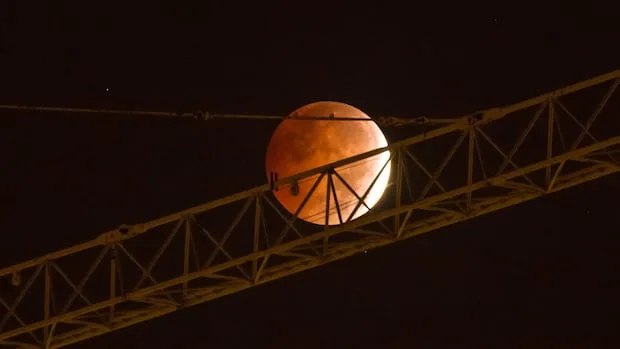
On the night of Aug. 27-28, a partial lunar eclipse will be visible across the country.
The eclipse comes roughly two weeks after the total solar eclipse that was seen across Iceland, Spain and a small portion of Portugal.
While this will be a partial eclipse, it will be a deep one, with 93 per cent coverage at its maximum.
Lunar eclipses occur when the moon moves through Earth’s shadow, called its umbra. Before it enters the umbra, however, it passes through Earth’s outer, dimmer shadow, called the penumbra. However, because it is much dimmer, it’s difficult to see with the naked eye when this occurs.
Most of Canada will see the entire duration of the eclipse, while Western Canada will see the partial eclipse already taking place as the moon rises.
NASA says it will put humans on the surface of the moon in 2028. How realistic is that?
The International Space Station is old and leaky. Should it be decommissioned sooner rather than later?
The great news is that, unlike with a solar eclipse, you don’t need any protective eyewear to watch the event.
Also unlike a solar eclipse, a lunar eclipse takes place over hours, not minutes.
The eclipse will begin as the moon enters Earth’s penumbra at roughly 10 p.m. ET, but that’s not when you want to go out to start observing.
Instead, the visible part of the eclipse begins at 10:33 p.m. ET on Aug. 27 and ends at 1:52 a.m. on Aug. 28. The deepest part of the eclipse will occur at 12:13 a.m. with almost all of the moon appearing darkened.
"It's kind of a fun one because … August had so many great things going on for it and still does," said Elaina Hyde, director of the Allan I. Carswell Observatory York University’s department of physics and astronomy in Toronto.
"We had, of course, the very, very partial solar eclipse back on August 12th. We had the Perseids, which were either fabulous or slightly less fabulous, depending on how cloudy your skies were. And, of course, the Jupiter-Mercury conjunction ."
"It's a partial eclipse, so it's not going to turn 100 per cent red, but depending on where you are in Canada, it will still be pretty red," Hyde said.
5News aggregated this summary from the outlet’s public feed. The full article, with all the context, is on www.cbc.ca — the content belongs to CBC Canada.