When can your child stay home alone? Neuroscience suggests we’re asking the wrong question
Would you trust your child to stay home alone? For many caregivers, the answer depends on age.
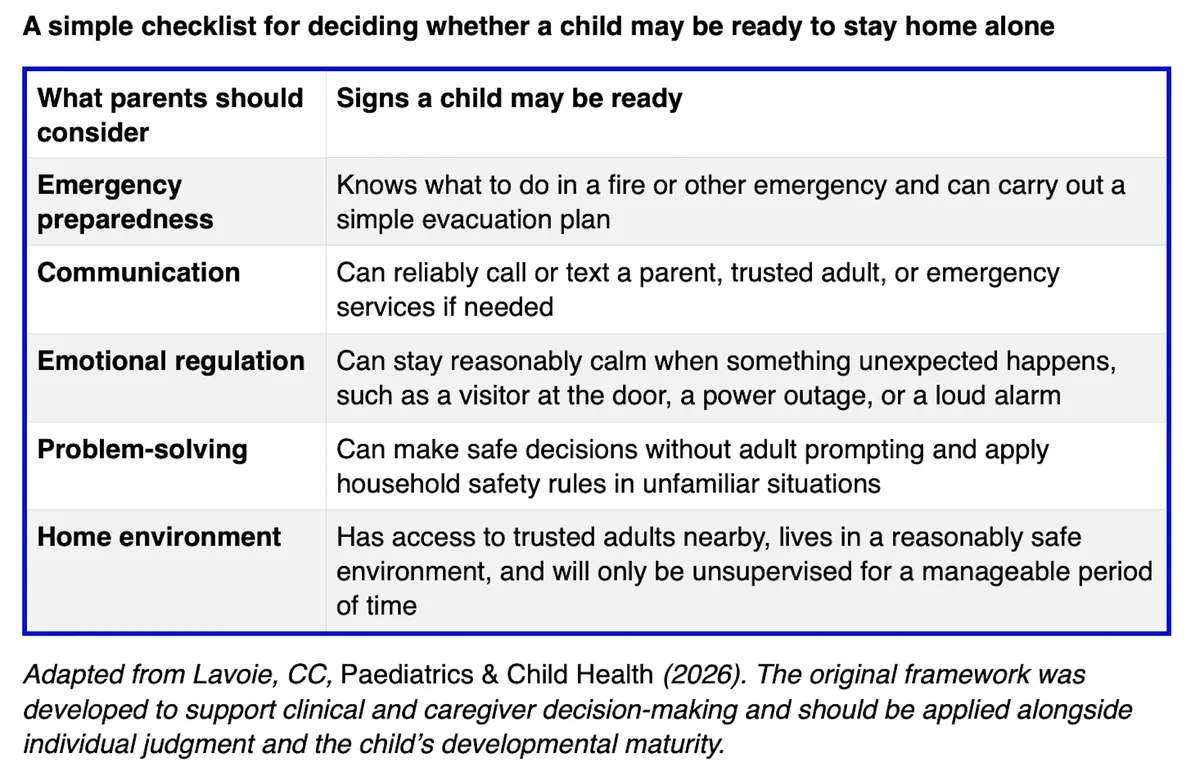
But when it comes to safety and independence, neuroscience suggests a different question may be more important: is your child developmentally ready to stay home alone? Caregivers will eventually face this question and must make the decision on when it’s safe to leave their child home alone, yet the answer is surprisingly unclear.
Depending on where you live, the guidance can vary widely, and many parents are left relying on their own childhood experiences or advice from friends and family to make this important decision.
As a pediatric neurologist, I study how children’s brains develop and how this affects judgment, decision-making and the ability to respond to unexpected situations.
I recently examined whether Canadian recommendations about children staying home alone are aligned with what neuroscience tells us about child development .
My findings suggest that rather than asking “How old is my child?” caregivers should be asking: “Is my child ready?” There is no magic age Parents often hope for a clear answer: 10, 11 or 12 years old.
But child development doesn’t work that way.
The brain systems involved in planning, impulse control, risk assessment and emotional regulation develop gradually throughout childhood and adolescence .
A child may be able to make a snack, follow a routine and use a phone independently, but still struggle to respond appropriately when something unexpected happens.
A knock on the door from a stranger, a younger sibling getting hurt or a small kitchen fire can have severe repercussions if a child is not developmentally ready to respond.
That is one reason why age alone is an imperfect measure of readiness.
Canada’s rules are surprisingly inconsistent Child supervision guidance across Canada follows a patchwork of recommendations.
Some provinces specify minimum ages in legislation (16 in Ontario, and 12 in New Brunswick in Manitoba), while others rely on broader child protection standards or offer no clear age guidance at all .
This means that two families with children of the same age may receive very different advice depending on where they live.
5News aggregated this summary from the outlet’s public feed. The full article, with all the context, is on theconversation.com — the content belongs to The Conversation Canada.