Canadian women's team makes 2nd appearance in international event as blind soccer continues to grow
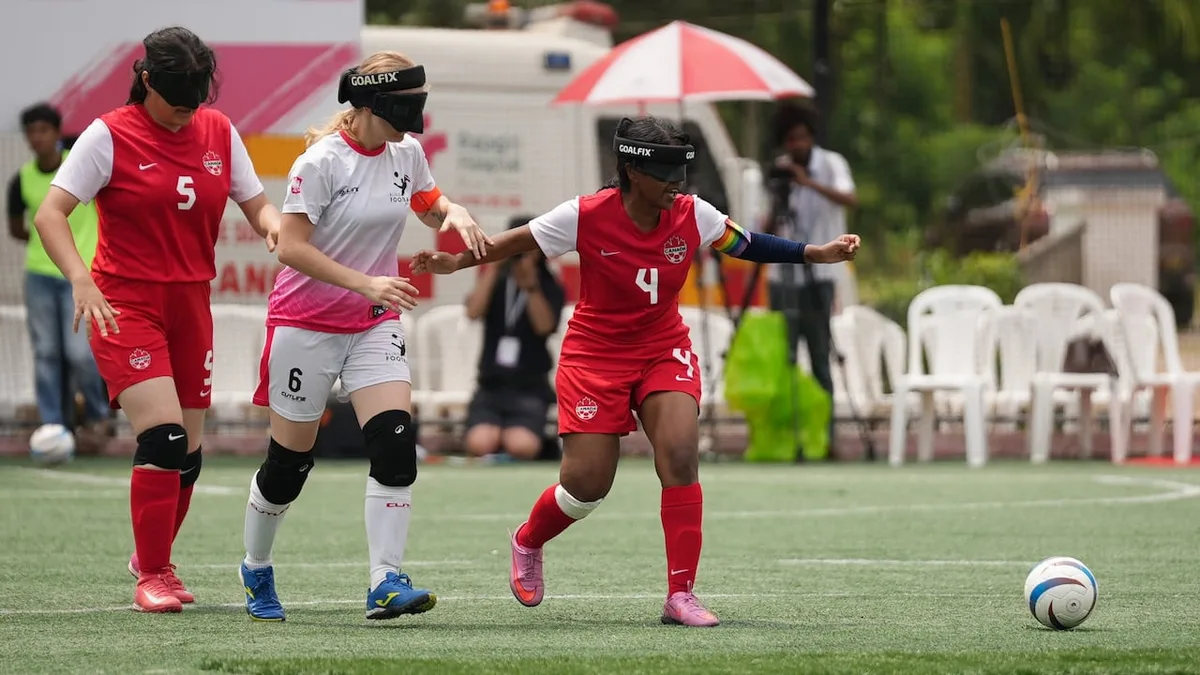
An audible ball rattles as it moves across the field, filled with small bells that jingle for everyone on the pitch to hear. The rest of the game runs on sound, too. Five players take the field for each side, with every outfield player wearing eyeshades to ensure those with some remaining sight have no advantage over teammates with none.
The sighted goalkeeper directs players from the back and a guide behind the opposing net calls attackers toward goal. Any player closing in on an opponent has to shout voy , Spanish for "I go," to warn them before the two collide.
It is a version of soccer that looks familiar only until the game begins. For Canada's women's blind national team, that unfamiliarity is part of the challenge. The program has spent the better part of a decade introducing Canadians to a sport many have never seen, while slowly building a competitive team of its own. This week, the team faces Argentina, Mexico and host Brazil at the IBSA Women's Blind Football American Championship, marking this as Canada’s second international competition. The event runs Sept. 3-9 in São Paulo.
When Matt Greenwood began working with the sport in 2017, there were eight recreational players in Canada. He estimates there are now about 30 competitive players nationwide, drawn from workshops and community sessions that have introduced the sport to more than 3,500 people, roughly 20 per cent of whom were born visually impaired or legally blind, with the rest losing their sight later in life.
Captain Hillary Scanlon is among the latter. She lost her vision unexpectedly in 2016, having played competitive soccer in Peterborough, Ont., as a teenager. It had always been her favourite sport, and after losing her sight she wanted to know whether she could keep playing.
She found blind soccer online and learned it was an Paralympic sport. What she could not find was a Canadian program. "There was really nothing," Scanlon said.
A small notice on the Ontario Soccer website led her to Greenwood, who was then working in accessible soccer, and the two began collaborating. The program was fully established in 2022.
The lack of a program was not the only obstacle. Echo boards surrounding the field are another essential part of blind soccer, giving players a reference point as they move. Canada has only one set, left behind after the 2015 Parapan American Games in Toronto and now housed at a camp near Lake Joseph in Muskoka, hours from where the national team trains in Pickering. Scanlon felt the consequences at last year's world championship in Kochi, India, when she went into the boards 10 minutes into Canada's opening game against Argentina and broke her hand.
"I was unfamiliar with how to play with them safely," Scanlon said. “That's a big gap in terms of safety as well."
Growing the sport across a country the size of Canada is its own challenge. Programs remain concentrated in a few pockets, mostly in Ontario, plus one in Burnaby, B.C., and another taking shape outside Halifax, leaving much of the country without a regular place to play.
5News aggregated this summary from the outlet’s public feed. The full article, with all the context, is on www.cbc.ca — the content belongs to CBC Sports.