Hiker receives lost backpack 63 years after he fell into Austrian glacier
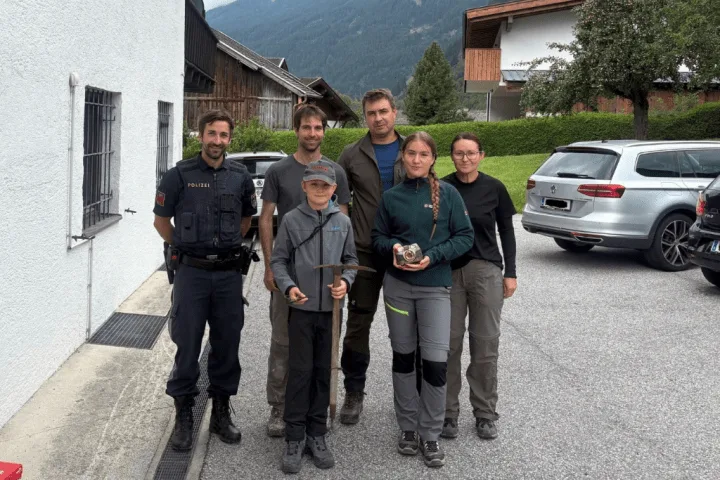
An 86-year-old hiker has been reunited with his backpack more than 60 years after he was forced to abandon it during a mountaineering emergency in Austria’s Tyrol region.
His long-lost belongings were preserved in glacial ice, but its melting led to their discovery last month when a hiker stumbled upon a backpack, an ice axe, a camera, and a pipe dating from the 1950s or 1960s, Austrian authorities said .
The hiker found the items on the Sulztalferner glacier at an altitude of 9,700 ft last month, prompting a police investigation.
“A barely legible name was eventually found in the badly weathered document folder. Further research led to the identification of the former owner. The now 86-year-old confirmed that the equipment was indeed his,” Tyrol state police said.
The owner left the items on the glacier on Aug. 4, 1963, when he and some friends went on a high-altitude hike in the Sulztalferner glacier area.
During the crossing, he fell into a crevasse. Because the group was roped together, his friends held him and freed him using prusik loops. To reduce his weight, he took off his backpack and threw it into the crevasse.
More than six decades later, the lost equipment has been returned to the man’s family.
He couldn’t travel to collect it for health reasons, so a mountain police officer handed the items to his son on Aug. 25.
The son told officers that the story of the lost backpack held great significance in the family, as if the man had not survived, his descendants would not have been here to collect his belongings.
The Tyrol region is steeped in history, and over time, relics of its past have emerged from the melting glacial ice.
Researchers have found coins, weapons, diaries, lanterns, canned food, bottles, clothes, straw beds and even the remains of soldiers in uniform who were stationed in the region during the First World War.
Many of the bodies and the artifacts that accompanied them were found in military barracks on Mount Scorluzzo, built inside a cave overlooking the Stelvio Pass in northern Italy near the Swiss border; the findings were detailed in Smithsonian Magazine, National Geographic, and The Guardian , with experts informing the latter that most of the exhumed soldiers likely died as a result of the frigid conditions, not in combat.
The barracks sheltered Italian soldiers as they fought Austro-Hungarian forces in a high-altitude mountain campaign known as the White War, a series of battles across the Alps between 1915 and 1918.
The barracks were known to exist, but only in 2015, once the glacier had sufficiently melted, was the icy catacomb excavated, as reported by The Guardian in 2021.
5News aggregated this summary from the outlet’s public feed. The full article, with all the context, is on globalnews.ca — the content belongs to Global News World.