Consensus reached on proposed corridor for road connecting Nunavut and N.W.T.
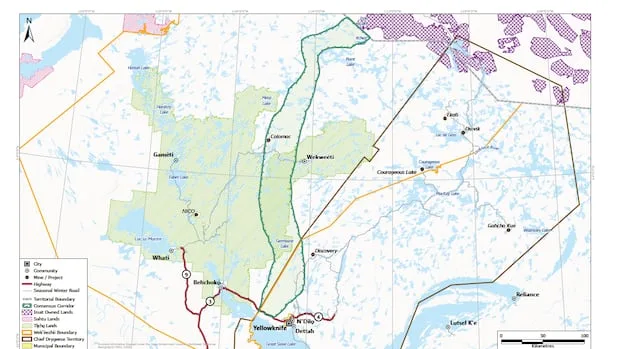
The Yellowknives Dene First Nation and the Tłı̨chǫ Government announced on Saturday they had reached a consensus on the proposed location for the Arctic Economic and Security Corridor.
The 400-kilometre all-season road would connect the Grays Bay Road and Port in Nunavut with the N.W.T. highway system. The project is one of the “nation-building projects” announced earlier this year, to expand military presence and mineral exploration in Northern Canada. For the N.W.T., it would also provide year-round road access to Wekweètì and Gamètì.
The project is being led by the the Yellowknives Dene First Nation and the Tłı̨chǫ Government, in partnership with the territorial and federal governments.
“It is exciting to show Canada how we can lead and design major projects as Indigenous nations,” said Tłı̨chǫ Grand Chief Jackson Lafferty in a statement.
The proposed corridor is a band roughly 30 kilometres wide, cutting through the Slave Geological Province. Leaders were quick to emphasize that the proposed corridor is just the first step in the process.
“This is a proposed corridor, not a final road, and that matters,” said Yellowknives Dene First Nation Chief Ernest Betsina and Chief Fred Sangris, in a joint statement.
As well as having potential for mineral exploration, the area is also part of caribou habitat and migration routes. In their statement, both nations stressed that the proposed corridor was drawn to “reduce impacts” on the caribou population.
“We chose this corridor to reduce the harm to caribou as much as we can, knowing a road in the barrenlands will still have impacts we must manage,” said Lafferty.
The consensus took over a year of work. In their statement, the two nations stated that the agreement drew on community-led studies, traditional knowledge and Western science. While they reached an agreement, both nations acknowledged in their statement that the corridor was “perhaps not the pathway either would have arrived at on its own.”
Premier R.J. Simpson said in a statement that the government of the Northwest Territories "respects the consensus" reached by the two nations, and is "committed to working alongside them."
“This is what Indigenous-led development and government-to-government partnership can look like,” Simpson said. “That matters beyond this project. The future of the Northwest Territories will depend on governments working differently together to advance major opportunities, with Indigenous governments as leaders and partners from the outset.”
Once completed, the corridor will be Canada’s first land-based link to Nunavut’s Arctic coast.
Next, the Tłı̨chǫ Government and Yellowknives Dene First Nation will be providing opportunities for their members, neighbouring Indigenous governments, and community members to weigh in on the proposed route.
“What people tell us in the weeks and months ahead will help shape the path forward,” Sangris and Betsina said in their statement.
5News aggregated this summary from the outlet’s public feed. The full article, with all the context, is on www.cbc.ca — the content belongs to CBC Canada.