Researcher studying Acadian wills says they were 'an act of resistance'
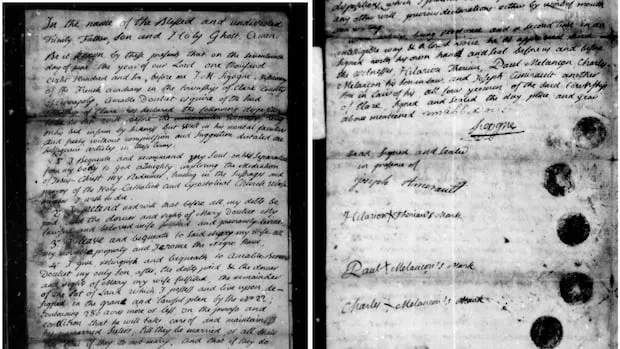
When Hilarion Thériault felt his time was coming at 71 years old, he decided to leave a will — an uncommon occurrence for Acadians in the 19th century.
That’s because many Acadians did not have much property to pass down. After the Acadian deportation, many lost their land and homes. Additionally, Roman Catholics in the province were not allowed to own property until the 1780s. While many occupied the land they lived and worked on, they struggled for decades to get land titles.
But Thériault was, as his will puts it, “unwilling to die unprepared.”
Colby Gaudet, a post-doctoral fellow at Dalhousie University, studied Thériault’s and 23 other wills from the small Acadian community of Clare, N.S., to better understand how some families navigated the legal and religious practices associated with grief and death.
“It's simultaneously both an act of resistance, but also adherence. [Acadians] using the model that's already there, these Anglophone property lines,” said Gaudet. “But they're also making clear that this is the will of a Roman Catholic.”
Thériault asked that his debts be paid and that reparations for any wrongdoing be made in his memory. His will also said that he wanted to provide peace for the family.
Maurice Basque, a historian at l'Institut d'études acadiennes at the Université de Moncton, said these wills were written in the context of great social shunning of Acadians.
In 1755, Lt.-Gov. Charles Lawrence ordered the deportation of the Acadians after they refused to align themselves with the British Crown. Thousands were forced out of their homes and many also escaped into the woods and to Quebec.
Basque said Acadian land became property of the Crown, which distributed it among settlers from New England.
“It was a plan for decades of the British to replace the Acadian population,” said Basque.
Some Acadians were able to return years later, but it was far from a warm welcome.
Basque said they were systematically kept from holding certain positions of power through oath tests, which were intended to make people renounce core Catholic beliefs.
Because of this, Gaudet said all of the county judges that looked over wills in the area were Anglo-Protestant, which added a language barrier for the Acadians, who had to somehow write their wills in a language many did not speak.
All of the wills Gaudet read were written by a priest named Jean-Mandé Sigogne, who left France due to the French Revolution, took refuge in London, where he learned English, and ended up in Clare in 1799.
5News aggregated this summary from the outlet’s public feed. The full article, with all the context, is on www.cbc.ca — the content belongs to CBC Canada.