Why more clothes donated to charity are going in the garbage
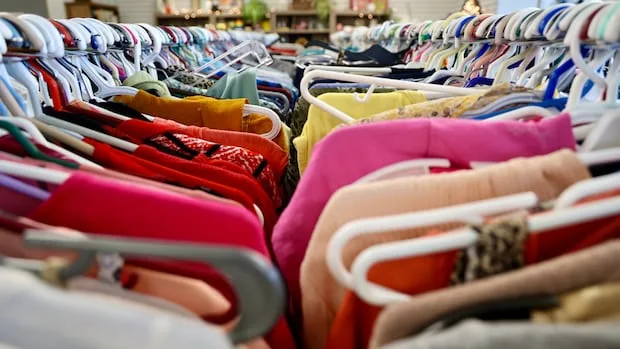
Kathy Broussard pulls back a curtain to reveal a mountain of plastic bags stuffed with used textiles. It’s a quarter — no, she self-corrects, an eighth — of all the donations her store has recently received.
The basement is also full, and two custom-made extra-large donation bins outside the store fill up every day.
“It’s a treadmill. It doesn’t end, it keeps coming and going,” she said.
Broussard’s staff and volunteers sort through the bags and sell what they can. Items that do not sell within about a month are put into bins where people can take them for free. Garments spend a day in the free bins before going in the dumpster.
“We need to find somewhere for it to go besides the landfill and I don’t know where that’s gonna be,” said Broussard, executive director of Hand in Hand, a non-profit thrift store in Halifax whose proceeds go to the Society of Saint Vincent de Paul.
For decades, many charity thrift stores across the country sold their surplus clothes to other non-profits, which would in turn sell the goods in bulk to support their own charitable causes. But in recent months, those arrangements have been falling apart.
Hand in Hand hasn’t had a buyer since February, and Broussard said she’s searched high and low for an alternative, without success. Dumpster pickups at her store have increased 50 per cent, and every pickup comes with a fee that eats into the charity’s bottom line and undermines Broussard’s desire to be a good environmental steward.
“Clothes really shouldn't go in the dumpster. But there's just so many clothes being generated now with fast fashion,” she said.
CBC News spoke to four other charity thrift operations that are in the same bind as Hand in Hand, but did not want to speak about it on the record.
Charlotte Genge, a textile circularity consultant, works with people in the used clothing industry across Canada. She said charity thrift stores are facing the same problem coast to coast: options are dwindling for getting rid of unsold stock.
“We're seeing just such an abrupt end to that collection mechanism. And it's really throwing people off, not only because they want to be environmentally friendly, but also because it costs them money to do it,” she said, referring to dumping fees.
Without a fix, she said she expects the volume of textiles going to local landfills to swell in the coming years.
“It almost needs to get worse before it's going to get better because it's been so out of sight, out of mind for so long.”
Genge said used clothes in Canada have historically cycled through thrift stores until they’re deemed unsellable, and then followed two possible paths: they’re repurposed (usually into industrial rags, stuffing or insulation) or they’re exported .
5News aggregated this summary from the outlet’s public feed. The full article, with all the context, is on www.cbc.ca — the content belongs to CBC News.