Food and shelter have driven Canada's affordability crisis. Health care isn't far behind
Rising food and shelter costs have been in the spotlight as drivers of the affordability crisis. But consumer price index (CPI) data shows that what Canadians pay to stay healthy has soared almost as much since overall inflation hit a peak in June 2022.
The jump in health-care costs may go under the radar for many Canadians, experts say — in part because many costs are covered by the public health-care system (which also means they aren't included in CPI data) and in part because typical out-of-pocket health expenses may be sporadic.
"You pay your rent every month and you pay your grocery bill every week," Jimmy Jean, vice-president and chief economist at Desjardins Group in Montreal, said in an interview with CBC News. "So it's very much in consumers' faces in a way that you couldn't say for a dental appointment that you have twice a year."
But health-care prices have nonetheless followed a "sharper curve" in recent years, said Andrew Longhurst, a senior researcher at the Canadian Centre for Policy Alternatives (CCPA) — one that may get steeper still.
"I think that growth is only going to increase as we see greater aging and we see provincial governments — especially among the larger provinces — really pulling back and choosing fiscal restraint and austerity," Longhurst said.
The overall measure of inflation — called all-items CPI — has risen a bit over 11 per cent since June 2022. The broad category called health and personal care has gone up much more — just over 15 per cent in that time, behind shelter costs (more than 16 per cent) and food prices (up almost 19 per cent).
But the subset of health-care services, which include things like eye exams, physiotherapy appointments and basic dental care, is up 18.5 per cent — nearly as much as food.
Federal health minister voices concern as Alberta implements dual-practice health-care model
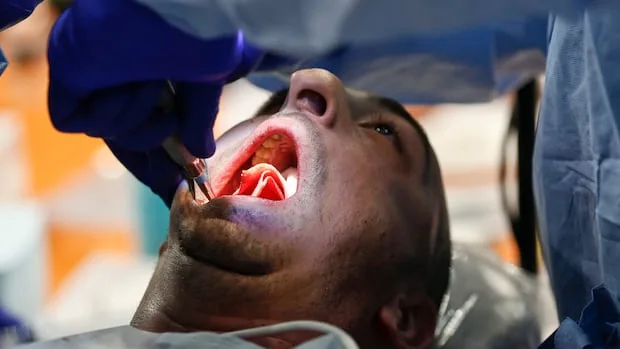
Dental care services and eye care goods have both seen prices rise 20 per cent since June 2022, and both are emblematic of a public-private split within the health-care industry, Longhurst said, with costs controlled on only one side.
"Prescription eyeglasses and contact lenses — most of that industry is all private for-profit, increasingly investor-driven, private equity is involved. And it's similar with dental care," he said. "These are areas where there is virtually no public provision, very limited not-for-profit provision, and there are no public constraints on what those costs are."
Statistics Canada data shows that the prices of health-care services have generally tracked well above overall inflation since well before the COVID-19 pandemic. In the previous 20 years, year-over-year inflation in health-care services has exceeded overall inflation 85 per cent of the time.
During that period, health-care services inflation was significantly lower than overall inflation only during the pandemic-era inflation spike — reflecting a period when other prices spiked, rather than a slowdown in health-care costs.
Part of the long-term trend is due to the economic realities of health and dental services, where a big expense is skilled labour costs, said the Desjardins Group's Jean.
"It's a function ...
5News aggregated this summary from the outlet’s public feed. The full article, with all the context, is on www.cbc.ca — the content belongs to CBC Canada.