What these salamanders could tell us about the health of Nova Scotian forests
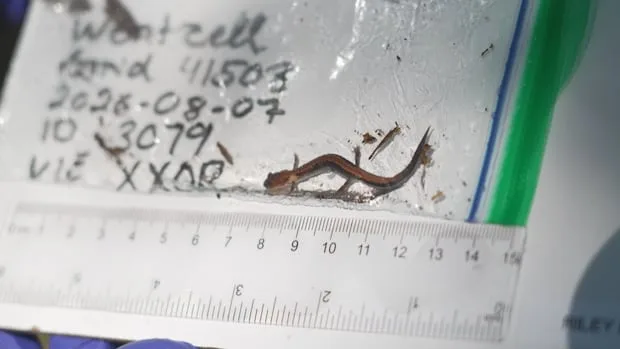
A researcher is trying to understand how an invasive bug and the chemicals used to kill it are affecting the species living in old hemlock forests.
Hemlock woolly adelgid (HWA) has been wreaking havoc on forests in southwestern Nova Scotia for almost a decade. To fight its spread, Parks Canada, the province, local organizations and private landowners have been using insecticides, namely imidacloprid and dinotefuran.
But Mathilde Christjansen, a master's student at Mount Allison University in Sackville, N.B., said little is known about if and how woolly adelgid and the insecticides used to fight it are impacting other species.
“[Imidacloprid] is intended to affect insect nervous systems, but they can also affect nervous systems in other animals,” she said. “It has been found in the brains of other animals like fish and tadpoles.”
Rather than studying all species in all hemlock forests one by one, Christjansen said the team is using one small amphibian to get a snapshot of the ecosystem.
“The eastern red-backed salamander is a really good bioindicator species because it's sensitive both to environmental conditions and to pollutants,” she said. “So if anything is happening with our eastern red-backed salamanders, that could be a really good indicator of how the forest is doing as a whole.”
New tools to save Nova Scotia's hemlocks come into use as species continues to decline
For the study, scientists placed coverboards on forests last year. The coverboards act as habitat for salamanders, so scientists periodically surveyed them to count salamanders living underneath them, measuring and tagging them in the process.
Some of the forests they are studying are being treated for HWA with both or either insecticide, and some aren’t treated at all.
The team also ran behavioural tests on the salamanders they found, like poking them lightly to see how they react to predation, and flipping them upside down to see how fast they get on their feet.
“If the salamander's not doing super well, say the populations are small or they have a lot of like health issues, or they're just smaller than other salamanders in non-treated forests or in treated forest, that could help inform whether other parts of the ecosystems are also being affected,” said Christjansen.
Julia Riley, an associate professor at Mount Allison University, one of the supervisors of the study and a Canada Research Chair in integrative wildlife ecology, said besides their reactivity to changes in the environment, salamanders are a great indicator of forest health because of their numbers.
“They're highly abundant. They make up a huge biomass of our forests. In fact, in woodlands in Eastern Canada, there are a greater biomass of eastern red-backed salamanders in most forests than there are deer,” she said. “Think of all the deer in the forest piled together and then think of more salamanders than that.”
The study is also looking at the impact that dying hemlocks have on the salamanders.
5News aggregated this summary from the outlet’s public feed. The full article, with all the context, is on www.cbc.ca — the content belongs to CBC Technology.