Expert urges joint monitoring in Himalayas to strengthen early warning
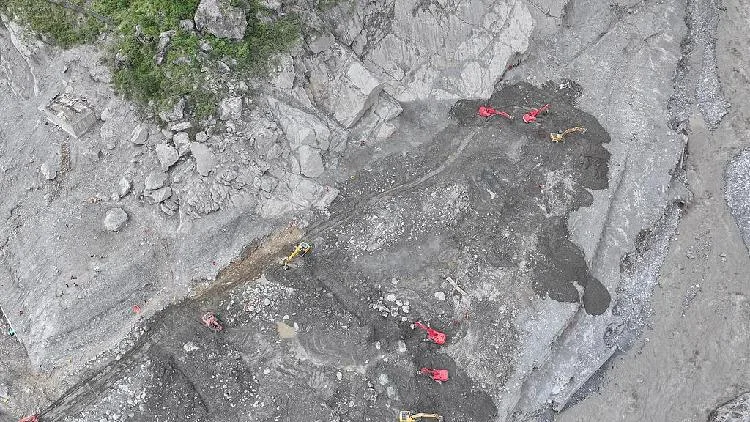
The source of the recent ice-rock avalanche and mudslide disaster in Gyirong County, southwest China's Xizang Autonomous Region, was located on the northern slope of Nepal's Langtang Lirung peak, which posed a major challenge for monitoring and early warning, experts said at a media briefing on Sunday.
Su Pengcheng, a researcher at the Institute of Mountain Hazards and Environment under the Chinese Academy of Sciences, said the ice-rock avalanche began at an altitude of about 5,200 meters, rapidly descended, scoured the mountain slopes and developed into a massive mudflow.
The flow traveled about 22 kilometers before reaching Gyirong Port in China at an elevation of around 1,800 meters.
The entire process took just six to seven minutes and caused severe damage downstream.
Following the disaster, runoff in the river channels has continued, with large amounts of loose glacial moraine and debris remaining along the channels, creating a potential risk of secondary blockages and barrier lakes.
Experts warned the main secondary risk is that large ice-rock collapses could block the river channel, posing a threat to rescue personnel downstream.
Therefore, authorities have conducted a comprehensive survey of geological hazards in the Donglin Zangbo river basin.
Remote sensing analysis, along with field surveys, show that the basin contains 26 glaciers larger than 1 square kilometer and 11 glacial lakes larger than 0.1 square kilometers, requiring continued monitoring.
Given that Gyirong Port is located in a remote, high-altitude region along the China-Nepal border, monitoring the ice-rock avalanche source area is highly challenging.
The source area is cold, oxygen-deficient and difficult to access, while cross-border river basins create observation gaps and ground-based equipment faces difficulties in power supply, communications and maintenance.
The hidden nature of disaster-chain precursors leaves only a few minutes for early warning, making traditional point-based monitoring unable to cover risks across the entire basin.
Considering the conditions of Gyirong Port, Su said future work should focus on three key areas: enhancing scientific understanding of disaster chains, developing integrated monitoring technologies and strengthening cross-border cooperation.
Improving research and early identification of warning signals The occurrence of ice-rock avalanches in the Himalayas is significantly driven by climate change, and the region is characterized by complex and diverse geological conditions and frequent tectonic activity, said Su.
此摘要由5News从媒体的公开信息源汇聚而成。 包含完整背景的全文在www.cgtn.com — 内容归CGTN Tech & Sci (oficial)所有。