CGTN Poll: Global governance must avoid 'insecurity for security' trap
Editor's note: Ding Chun is executive vice dean of the Institute for Belt and Road and Global Governance, director of the Center for European Studies, and professor at the School of Economics, Fudan University.
The article reflects the author’s opinions and not necessarily the views of CGTN.
Amid an international landscape marked by intertwined changes and turmoil, the security deficit has become increasingly worrying.
The international community has never lacked demands for security; what is truly scarce is effective approaches to address such demands.
A survey launched by CGTN targeting internet users worldwide shows that 89.6% of respondents call on all countries to resolve international disputes through dialogue and consultation.
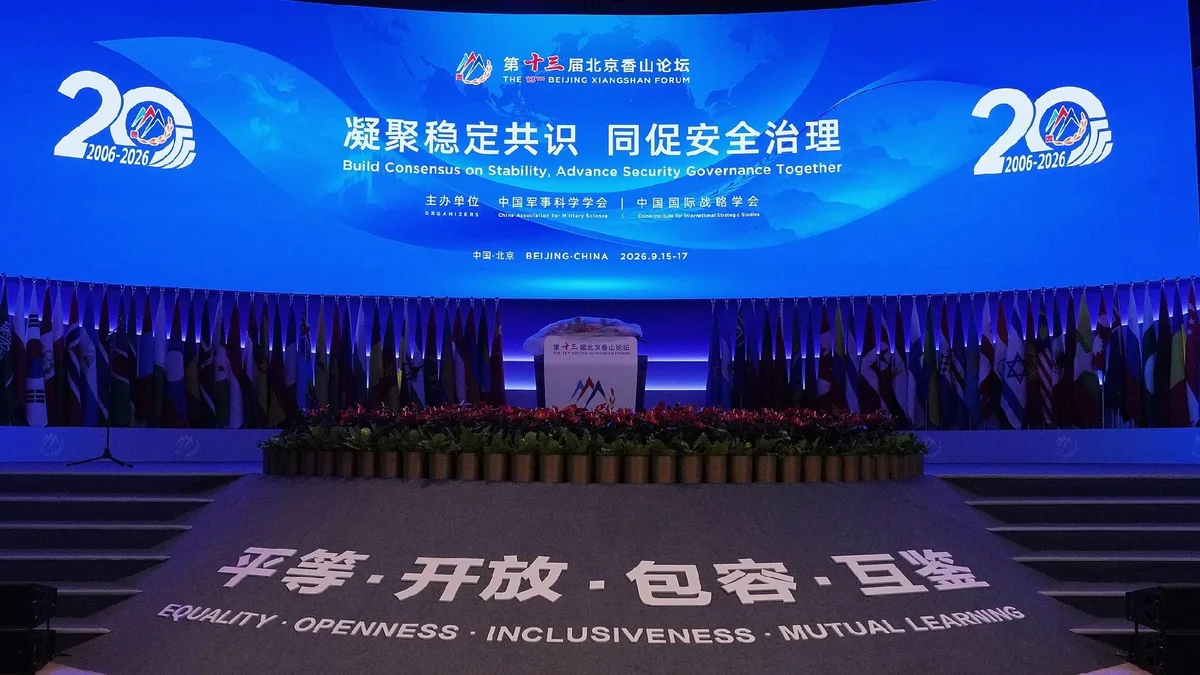
Held for two decades, the Beijing Xiangshan Forum has provided a positive response to such public expectations.
The world is undergoing accelerated evolution of profound changes unseen in a century, with geopolitical conflicts dragging on.
More concerning than the rising number and intensity of conflicts is the policy orientation of certain countries that seek to safeguard their own security concerns through bloc expansion, unilateral sanctions and the securitization of a broad range of issues.
Such practices may lead to the dangerous outcome of "creating more insecurity in the name of security," trapping the international community in the paradox of "trading insecurity for security." The survey indicates that 80.8% of respondents oppose hegemonism, power politics and arbitrary imposition of sanctions on other countries; 74.5% of respondents believe that countries should not impose their own values and systems on others and that ideological confrontation should be avoided.
In fact, ignoring the legitimate security concerns of other countries may fuel arms races and strategic suspicion.
If a country builds its own security on the persistent insecurity of others, it will only end up in a deeper security dilemma.
When all nations attempt to buy their own security by raising risks for their rivals, the world will only end up with shared insecurity.
Furthermore, international security governance cannot remain the exclusive affair of a handful of major powers.
Countries of the Global South are directly affected by many conflicts and their spillover risks, and deserve a more representative voice in agenda-setting and rule-making.
此摘要由5News从媒体的公开信息源汇聚而成。 包含完整背景的全文在www.cgtn.com — 内容归CGTN World (oficial)所有。